Author: george@quokkaprints.com

  • How Many Lab Coats Should You Order?

    Call or Text us: (929) 605-4397

    HomeBlog › How Many Lab Coats Should You Order?

    Ordering

    How Many Lab Coats Should You Order?

    06/12/2026

    Corporate wellness team wearing custom lab coats stacked and ready for distribution

    Deciding how many custom lab coats to order is the first practical question every buyer hits, and getting it roughly right saves both money and a mid-year scramble. Order too few and staff are short a coat during laundering; order too many and unused coats sit in a supply closet tying up budget that could go elsewhere.

    Here is the practical framework we walk hospitals, clinics, pharmacies, schools, and wellness programs through when sizing an order.

    Start with headcount, not a round number

    The cleanest starting point is your actual staff or student headcount who will wear the coat — not a round number that sounds convenient. Count every role that wears a coat: physicians, nurses, technicians, pharmacists, front-desk staff, students, or program participants, depending on your setting.

    Add a laundry-rotation buffer

    Coats worn daily and laundered frequently need more than a one-per-person count. A common rule of thumb is 1.5 to 2 coats per person for daily-wear clinical roles, so staff always have a clean coat while another is in the wash. Lower-frequency wearers — occasional clinical visitors, part-time staff, or wellness program participants who wear a coat a few times a month — can typically get by on one coat each.

    Factor in new hires and turnover

    If your organization hires or turns over staff regularly, add a modest buffer — typically 10 to 15 percent of your base order — so new hires can be outfitted without triggering a whole new production run for a handful of coats. This buffer also covers the occasional damaged or lost coat.

    Quantity guidance by scenario

    ScenarioTypical quantityBest style
    Single small practice or pharmacy25–50Classic or Consultation coat
    Medical or nursing school cohort30–250Student Lab Coat
    Hospital department50–200Classic Full-Length
    Full hospital system500–2,000+Mixed styles by department
    Corporate wellness program25–150Warm-Up Lab Jacket
    Veterinary practice25–60Consultation (Short)

    Choosing for your order

    When your calculated quantity lands close to the next price break, it is almost always worth rounding up — the per-unit cost typically drops enough at the next tier that the extra coats cost very little in real terms, and any surplus covers next year’s new hires without a second production run. Since our minimum order is just 25 units, even a single department or a small independent practice can order a properly sized, professionally decorated batch without over-committing.

    Key takeawayPlan on 1.5–2 coats per person for daily-wear clinical roles, add a 10–15% buffer for new hires and turnover, and round up to the next price break when you are close.

    Ready to size your order? Get a custom quote — free mockups in 24–48 hours. Learn more about how we work, or browse more guides.

    More posts

  • Poly-Cotton vs. 100% Cotton Lab Coats: Choosing the Right Fabric

    Call or Text us: (929) 605-4397

    HomeBlog › Poly-Cotton vs. Cotton Lab Coats

    Buyer guides

    Poly-Cotton vs. 100% Cotton Lab Coats: Choosing the Right Fabric

    06/05/2026

    Research lab staff wearing custom lab coats in poly-cotton twill fabric at a lab bench

    Fabric choice gets less attention than logo placement or decoration method, but it drives more of a lab coat’s real-world performance than almost anything else — how it holds up to industrial laundering, how it wears across an eight-hour shift, and how crisp the embroidery looks after year one. We offer two core fabric families: poly-cotton twill and premium cotton-blend. Here is how to choose between them.

    Both fabrics take embroidery and heat-pressed decoration well; the difference is in day-to-day performance and long-term cost per wear.

    Poly-cotton twill: the durability default

    Poly-cotton twill blends polyester with cotton, which gives it strong wrinkle resistance, a crisp finish straight out of the dryer, and excellent dimensional stability through repeated hot-water and high-heat industrial laundering. It is the fabric we recommend by default for hospital, clinic, and pharmacy programs where coats are washed frequently and need to look sharp with minimal ironing.

    Premium cotton-blend: comfort for long shifts

    Premium cotton-blend fabric leans more heavily toward natural cotton fiber, trading a bit of wrinkle resistance for a softer hand and better breathability. Staff who wear a coat for a full shift, especially in warmer environments or under additional layers, often notice and prefer the difference. It is a common upgrade choice for physician and senior staff coats where comfort and feel carry a bit more weight than in a high-turnover student or technician program.

    Side-by-side comparison

    FactorPoly-cotton twillPremium cotton-blend
    Wrinkle resistanceExcellentGood
    Breathability / comfortGoodExcellent
    Wash durability (industrial cycles)ExcellentVery good
    Embroidery holdExcellent, crisp stitchingExcellent, slightly softer hand
    Best forHospitals, clinics, pharmacies, high-wash programsPhysicians, long shifts, comfort-first programs

    Embroidery hand and appearance

    Both fabrics take embroidery cleanly, but the tighter weave of poly-cotton twill gives stitching a slightly crisper, more defined edge, which matters for detailed logos or small text like a nameplate. Premium cotton-blend has a softer surface that some buyers feel gives embroidery a more natural, less “stiff” look — a matter of preference more than a durability difference.

    Cost per wear

    Poly-cotton twill typically sits at the lower end of our $22–$48 per unit range at the 25-unit minimum, while premium cotton-blend runs toward the higher end given the material cost. Over a coat’s full usable life, though, cost per wear tends to even out: poly-cotton’s durability stretches its usable life through more wash cycles, while premium cotton-blend’s comfort often means staff simply prefer wearing it, which is its own kind of value.

    Choosing for your order

    Choose poly-cotton twill as your default for high-frequency laundering programs — hospitals, clinics, pharmacies, and student cohorts. Choose premium cotton-blend when comfort over a long shift is the priority and coats are laundered on a more moderate schedule. If you are outfitting a mixed team, it is common to order poly-cotton twill for general staff and premium cotton-blend for physician or senior-level coats.

    Key takeawayPoly-cotton twill wins on durability and wrinkle resistance for heavily laundered programs. Premium cotton-blend wins on shift-long comfort where laundering is less frequent.

    Not sure which fabric fits your program? Get a custom quote — free mockups in 24–48 hours, and we will recommend a fabric based on your wash schedule. Learn more about how we work, or browse more guides.

    More posts

  • A Pharmacy’s Guide to Branded Lab Coat Programs

    Call or Text us: (929) 605-4397

    HomeBlog › A Pharmacy's Guide to Branded Lab Coat Programs

    Pharmacies

    A Pharmacy's Guide to Branded Lab Coat Programs

    05/22/2026

    Pharmacist wearing a custom embroidered lab coat with pharmacy logo behind the counter

    A pharmacist’s lab coat is one of the few pieces of branding a customer sees up close, at the counter, during a conversation about their own health. For independent pharmacies competing against national chains, and for multi-location groups trying to look consistent across every storefront, a well-run coat program is a small investment that pays back in trust and in fewer re-order headaches down the line.

    Here is how pharmacies typically approach a branded lab coat program, from a single independent location to a regional chain.

    Why the coat matters at the counter

    Patients associate a clean, professional, clearly-branded coat with competence — it is a visual shortcut for “this pharmacy is legitimate and organized.” An embroidered pharmacy name and pharmacist’s name on the coat also personalizes the interaction, which independent pharmacies can use as a genuine differentiator against the more anonymous experience at a big-box chain counter.

    Independent pharmacies: start small, build consistency

    A single-location independent pharmacy typically starts at or near our 25-unit minimum — enough to cover pharmacists and pharmacy technicians with a couple of spares for laundering rotation. The goal at this stage is less about volume and more about locking in consistent artwork (logo placement, thread colors, nameplate format) so every future re-order matches exactly, even years later.

    Multi-location groups: standardize once, order many times

    Pharmacy groups running multiple storefronts benefit most from standardizing the coat spec once — same fabric, same logo placement, same color options — then letting individual locations re-order against that spec without re-designing anything. This cuts the friction that usually slows down multi-location ordering: a new store manager can request coats for their location using the exact same file we have on record, with no design back-and-forth.

    Order sizing by pharmacy type

    Pharmacy typeTypical order sizeReorder cadence
    Single independent location25–40 coatsAnnually or as staff turns over
    Small regional group (3–8 locations)25–50 coats per locationRolling, per-location as needed
    Larger pharmacy chain100–500+ coatsScheduled bulk re-orders

    Fabric and decoration choices for pharmacy settings

    Pharmacy staff wear coats for full shifts on their feet, so comfort matters as much as durability. Poly-cotton twill is the common default for its wrinkle resistance and clean embroidery hold; premium cotton-blend fabric is worth the upgrade for staff who prioritize a softer hand over a full shift. Embroidery remains the standard decoration for pharmacy coats given the regular laundering schedule most pharmacies keep — heat-pressed decoration is a reasonable lower-cost option for seasonal or part-time staff coats that see less wear.

    Choosing for your order

    Start with a consistent artwork spec even on a first small order — it is what makes every future re-order effortless. Independent pharmacies should expect to land near our 25-unit minimum for a first order; multi-location groups benefit most from locking the spec once and letting each location re-order independently against it.

    Key takeawayLock in your artwork and fabric spec on the first order, even if it is small — it is what makes every future re-order, at any location, fast and consistent.

    Building a coat program for your pharmacy? Get a custom quote — free mockups in 24–48 hours. Learn more about how we work, or browse more guides.

    More posts

  • Custom Lab Coats for Hospitals & Clinics

    Call or Text us: (929) 605-4397

    HomeBlog › Custom Lab Coats for Hospitals & Clinics

    Hospitals

    Custom Lab Coats for Hospitals & Clinics

    05/08/2026

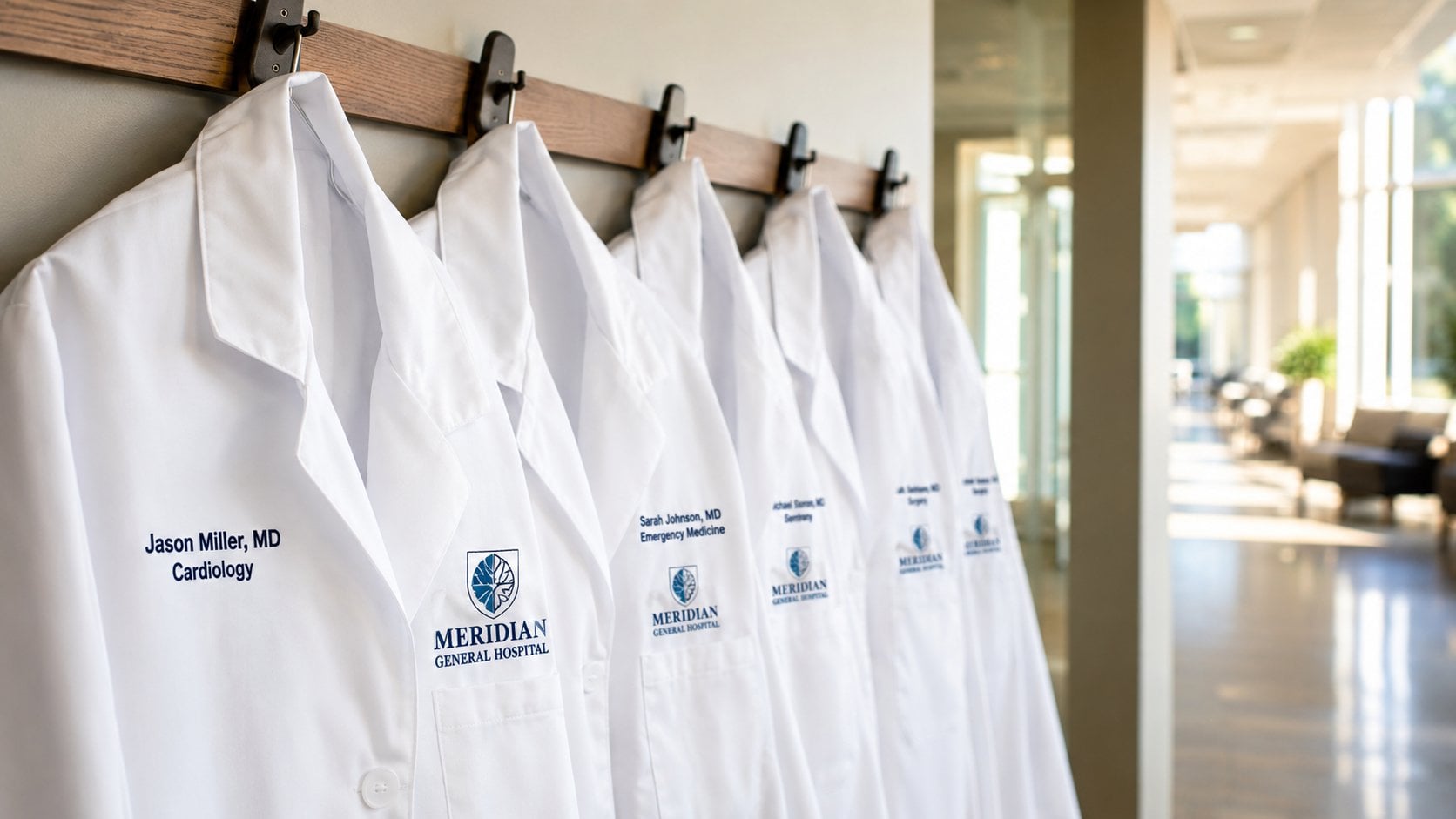
    Hospital staff wearing custom embroidered lab coats with department names in a clinic hallway

    Walk into any well-run hospital or multi-site clinic group and the staff coats tell you something before anyone speaks: department, role, sometimes seniority — all embroidered clearly enough to read from a few feet away. For patients navigating an unfamiliar building, that visual clarity builds trust fast. For the organization, a standardized coat program is also a quiet piece of internal operations, making it obvious at a glance who belongs where.

    Here is how hospitals and clinic groups typically structure a custom lab coat program, and what to think through before placing an order across multiple departments or sites.

    Why hospitals standardize coats by department

    A hospital with cardiology, radiology, and internal medicine departments benefits from coats that share a consistent hospital-wide logo but distinguish department or role through embroidered text — a name, title, and sometimes a department name on the chest. This lets patients and visiting staff identify roles instantly while keeping the whole organization visually unified under one brand.

    Multi-site clinic groups: consistency across locations

    Clinic groups running several locations face a different challenge: keeping the same look and quality across sites that may order independently or on different schedules. Standardizing on one supplier, one artwork file, and one fabric spec means a clinic opening its fifth location gets coats that are indistinguishable from the first — same thread color, same placement, same fabric weight — without re-negotiating specs each time.

    Embroidery is the standard for high-frequency clinical laundering

    Hospital and clinic coats are laundered far more often than most branded apparel, frequently on hot commercial cycles to meet infection-control protocols. Embroidered names and logos hold up to hundreds of these cycles without fading or cracking, which is why nearly every hospital-scale program we run uses embroidery rather than heat-pressed decoration — the up-front cost is offset by years of usable life per coat.

    Ordering across departments: quantity guidance

    Organization typeTypical order sizeNotes
    Single department (e.g. radiology)25–75 coatsMeets our 25-unit minimum easily
    Full hospital, multiple departments200–1,000+ coatsOrder in department batches with shared artwork
    Multi-site clinic group (per site)25–100 coats per locationKeep artwork and fabric spec identical across sites
    Annual new-hire top-up10–40 coatsBatch with next department order to hit MOQ

    Personalization at scale

    Individual name embroidery is standard practice for hospital and clinic orders — send a spreadsheet with each staff member’s name and title, and every coat in the batch comes back personalized without slowing down production. This is the single most requested customization for healthcare orders, and it is included in the standard embroidery process, not an upcharge tier.

    Choosing for your order

    For a hospital or clinic group, the priorities are consistency across departments and sites, embroidery for laundering durability, and individual name personalization collected up front via a staff roster. Order in batches sized to your department or site headcount and keep your artwork on file so future departments or new locations match exactly.

    Key takeawayStandardize on one artwork file and one fabric spec across every department and site, use embroidery for durability under hospital-grade laundering, and personalize with individual names from a staff roster.

    Outfitting a department or a multi-site clinic group? Get a custom quote — free mockups in 24–48 hours. Learn more about how we work, or browse more guides.

    More posts

  • Lab Coat Sizing Guide: Fit for Every Team Member

    Call or Text us: (929) 605-4397

    HomeBlog › Lab Coat Sizing Guide

    Buyer guides

    Lab Coat Sizing Guide: Fit for Every Team Member

    04/24/2026

    Plus-size and tall custom lab coat fit next to standard-fit lab coat for comparison

    A bulk lab coat order almost never goes to a uniform group of bodies — it goes to front-desk staff, physicians, technicians, and students who range across every standard size plus petite, tall, and plus-size needs. Getting sizing right the first time is the difference between an order that arrives ready to wear and one that turns into a round of exchanges and delayed onboarding.

    Here is how we recommend approaching sizing across a mixed team, plus the fit options available across our product line.

    Start with a size-by-headcount list, not a guess

    The single biggest sizing mistake buyers make is ordering a standard bell-curve distribution (heavy on M and L) without actually checking against their team. Send a simple size-collection form to your staff or students before you submit your quote — full name, role, and coat size — and use that list as the order sheet. It takes a day to collect and eliminates almost all post-delivery exchanges.

    Fit categories across our product line

    Standard sizing runs XS–XXL across our Classic Full-Length and Consultation (Short) coats. Beyond standard sizing, we offer:

    • Women’s Tailored Lab Coat — a fitted silhouette through the waist and shoulders, sized specifically for a women’s frame rather than a unisex cut sized down.
    • Plus-Size & Tall Lab Coat — extended sizing (up to 5XL) and separate tall-length options for staff who find standard-length coats too short in the body or sleeve.
    • Student Lab Coat — a lighter-weight, lower-cost cut suited to cohorts that reorder every year or two as class sizes change.

    Length matters as much as width

    Full-length coats typically fall mid-thigh to knee-length and suit physicians, pharmacists, and lab staff who want the traditional professional silhouette. Consultation (short) coats hit around hip-length and are popular with nursing staff, technicians, and anyone doing hands-on clinical work where a longer coat gets in the way.

    Fit needRecommended styleSize range
    Standard unisex fitClassic Full-LengthXS–XXL
    Active clinical work, shorter lengthConsultation (Short)XS–XXL
    Fitted women’s silhouetteWomen's Tailored Lab CoatXS–XXL
    Extended sizing or tall lengthPlus-Size & Tall Lab CoatUp to 5XL, tall options
    Student cohorts, budget-consciousStudent Lab CoatXS–XXL

    What to do when you are not sure

    If a staff member is between sizes or unsure, our general guidance is to size up rather than down — a slightly loose lab coat layers comfortably over scrubs or business clothes, while a too-small coat is unwearable. For plus-size or tall team members, flag it on your size list rather than ordering standard sizing and hoping; our Plus-Size & Tall line exists specifically so nobody on your team gets left with an ill-fitting coat.

    Choosing for your order

    Collect real sizes from real people before you order, choose the style that matches how the coat will actually be worn (full-length for a traditional look, short for hands-on clinical work), and flag any plus-size or tall needs up front so they are built into the order rather than fixed afterward.

    Key takeawayA size-by-headcount list collected before ordering eliminates almost all post-delivery exchanges — and our Plus-Size & Tall and Women's Tailored styles mean no one on your team has to settle for an ill-fitting coat.

    Ready to size your order? Get a custom quote — free mockups in 24–48 hours. Learn more about how we work, or browse more guides.

    More posts

  • Custom Lab Coats for Medical & Nursing Schools

    Call or Text us: (929) 605-4397

    HomeBlog › Custom Lab Coats for Medical & Nursing Schools

    Nursing schools

    Custom Lab Coats for Medical & Nursing Schools

    04/10/2026

    Nursing students wearing custom embroidered short lab coats with school crest during clinical training

    A white coat is one of the first professional milestones a medical or nursing student earns, and the school crest embroidered on it is often the first piece of institutional branding a student wears in public. For programs running white-coat ceremonies, clinical rotations, or simulation labs, a custom lab coat program does three jobs at once: it builds cohort identity, it signals professionalism to patients and preceptors during rotations, and — run through the campus bookstore — it becomes a small, steady revenue line.

    Here is how medical and nursing programs typically structure a coat program, and what to consider before you order for an incoming cohort.

    Cohort identity and the white-coat ceremony

    Most programs order a batch tied to a specific class year or cohort, embroidered with the school name or crest plus a designation like “Class of 2027” or the program name (BSN, PA, MD). Ordering by cohort rather than open-ended keeps the branding consistent for a ceremony photo line and gives every student the same coat on day one, regardless of when they joined the program.

    Choosing between the Classic and Student coat styles

    Our Student Lab Coat is cut and priced for programs ordering in volume every year, while the Classic Full-Length and Consultation (Short) styles suit programs that want their students in the same coat style faculty and staff wear. Many nursing programs prefer the short consultation-length coat for clinical rotation comfort, while medical schools more often choose the full-length coat to match the traditional white-coat ceremony look.

    Decoration: embroidery is the standard for student programs

    Embroidered school crests and program names hold up through a student’s full enrollment of repeated hot-water laundering — a meaningful consideration since many programs require coats to be laundered after every clinical shift. Heat-pressed decoration is a lower-cost alternative some programs choose for a single semester’s cohort or a smaller specialty track, where the coat’s usable life is short by design.

    Sizing across a diverse student body

    Student cohorts span a wide range of body types, and getting sizing right the first time avoids a scramble of exchanges during orientation week. We recommend collecting sizes directly from incoming students via a simple form (S–XXL, plus petite and tall options) before the order is placed, rather than guessing at a standard distribution.

    Program typeTypical order sizeRecommended style
    Small nursing cohort (30–60 students)30–75 coatsStudent Lab Coat
    Medical school class100–250 coatsClassic Full-Length
    PA / clinical specialty track25–60 coatsConsultation (Short)
    Bookstore stock (year-round)50–150 coatsMixed sizes, Student Lab Coat

    Running it through the bookstore

    Programs that stock coats through the campus bookstore typically order a mixed-size batch at the start of the academic year, sized against historical enrollment, then re-order smaller top-up batches as sizes sell through. Keeping your artwork and size run on file with us makes a mid-year top-up order fast — no need to resend logo files or renegotiate pricing.

    Choosing for your order

    Order by cohort with a collected size list, pick embroidery if the coat needs to survive a full clinical rotation schedule, and keep your crest artwork on file for easy re-ordering each academic year. Our 25-unit minimum makes it realistic to order for a single specialty track or a full incoming class.

    Key takeawayOrder student coats by cohort with sizes collected in advance, choose embroidery for anything that survives a clinical rotation schedule, and keep artwork on file for annual re-orders.

    Planning a coat program for an incoming class? Get a custom quote — free mockups in 24–48 hours. Learn more about how we work, or browse more guides.

    More posts

  • Embroidered vs. Heat-Pressed Lab Coats: Which Lasts Longer

    Call or Text us: (929) 605-4397

    HomeBlog › Embroidered vs. Heat-Pressed Lab Coats

    Buyer guides

    Embroidered vs. Heat-Pressed Lab Coats: Which Lasts Longer

    03/27/2026

    Close-up comparison of embroidered logo and heat-pressed logo on white lab coats

    Every practice ordering custom lab coats eventually asks the same question: embroidered or heat-pressed? Both methods put your name, logo, and title on the coat, but they behave very differently after the fiftieth industrial wash cycle — and that difference matters more for lab coats than almost any other branded apparel, since coats get laundered far more often than a polo or a jacket.

    Here is a straight comparison of both methods across the things that actually matter for a clinical or lab environment: durability, cost, turnaround, and appearance.

    How each method works

    Embroidery stitches your logo and any nameplate text directly into the fabric with polyester or rayon thread, using a digitized version of your artwork. Heat-pressed decoration (vinyl or digital transfer) applies a thin layer of colored material to the fabric surface using heat and pressure. Embroidery sits on top of the fabric with dimension and texture; a heat press lies flat against the surface.

    Durability: the deciding factor for lab coats

    Lab coats are laundered constantly — often on hot-water, high-heat commercial cycles to meet infection-control standards. Embroidery holds up to hundreds of these cycles with no cracking, peeling, or fading, because the thread is woven into the garment rather than sitting on the surface. Heat-pressed decoration is durable for typical wear, but repeated hot-water laundering and high-heat drying will eventually cause edge-lifting or surface cracking over time, especially at high-friction points like a chest pocket edge or a repeatedly-tucked collar.

    Side-by-side comparison

    FactorEmbroideredHeat-pressed
    Wash durability200+ industrial cycles, no fadingGood for 50–100 cycles before edge wear
    Cost per unitHigher (toward $48/unit at MOQ)Lower (toward $22/unit at MOQ)
    TurnaroundStandard 2–3 weeksOften faster, same 2–3 week window
    Look and feelRaised, textured, premiumFlat, smooth, clean modern look
    Best forHospitals, clinics, pharmacies, long-term staff programsStudent cohorts, short programs, tight budgets

    Cost and turnaround

    Heat-pressed decoration is generally the more budget-friendly option, which is why it is common for medical and nursing school cohorts that reorder every year or two as classes turn over. Embroidery costs more per unit but the cost is spread over a much longer usable life — for a hospital or clinic staff coat that gets washed weekly for two or three years, embroidery is almost always the better cost-per-wear decision even though the upfront price is higher.

    Choosing for your order

    If your coats will be laundered on hot commercial cycles multiple times a week for a staff that keeps them for years, choose embroidery — it is built for exactly that. If you are outfitting a student cohort that will replace coats within a year or two, or you are working with a tight per-unit budget on a large order, heat-pressed decoration is a smart, honest trade-off. If you are not sure, tell us your expected wash frequency and how long staff typically keep a coat, and we will recommend the method that makes sense for your program.

    Key takeawayEmbroidery wins on long-term durability for heavily laundered clinical coats. Heat-pressed wins on upfront cost and fits shorter-cycle programs like student cohorts.

    Ready to compare both on your own logo? Get a custom quote — free mockups in 24–48 hours show both decoration methods side by side. Learn more about how we work, or browse more guides.

    More posts

  • How to Order Custom Lab Coats for Your Practice: A Step-by-Step Checklist

    Call or Text us: (929) 605-4397

    HomeBlog › How to Order Custom Lab Coats

    Ordering

    How to Order Custom Lab Coats for Your Practice: A Step-by-Step Checklist

    03/13/2026

    Embroidered lab coats laid out for a bulk order for a medical practice

    Ordering custom lab coats for the first time — or re-ordering for a growing practice — comes with more decision points than most buyers expect: decoration method, fabric weight, sizing across a mixed staff, and how to keep everything consistent for the next re-order. Get those decisions right up front and the process from quote to delivered coats is fast and painless.

    Here is the exact checklist we walk practices, schools, and pharmacies through, whether the order is 25 coats for a single clinic or 500 for a hospital system.

    1. Gather your basics before you request a quote

    Have your practice or organization name, a logo file (vector — AI, EPS, SVG, or PDF — if you have one), a rough headcount by role, and a target delivery date. Approximate numbers are fine at this stage; quantities and sizes get firmed up during the mockup step. If you do not have a vector logo, send a photo or a PDF letterhead and our design team will recreate it print-ready at no charge.

    2. Decide embroidered or heat-pressed

    Embroidered nameplates and logos are the standard for clinical settings — they hold up to hundreds of industrial wash-and-dry cycles without cracking or fading, and they read as more premium at the collar or chest. Heat-pressed (vinyl transfer) decoration costs less per unit and turns around faster, which makes it a reasonable choice for short-term programs, student cohorts that turn over every year, or budget-constrained orders where wash-durability matters less. If you are not sure which fits your program, tell us your expected wash frequency and budget and we will recommend one.

    3. Pick fabric and color

    We work in poly-cotton twill and premium cotton-blend fabrics, available in White, Ceil blue, Navy, Black, and Pink. Poly-cotton resists wrinkling and holds embroidery stitching cleanly through repeated laundering — the right default for most clinical and pharmacy programs. Premium cotton blends breathe better for staff who wear a coat for a full shift and prefer a softer hand. If you are not sure, mark “not sure yet” on the quote form and we will recommend a fabric based on how the coats will be used.

    4. Confirm sizing across your team

    Lab coats are worn by a wider range of body types than almost any other branded apparel category — front-desk staff, physicians, students, and technicians all in the same order. Collect a simple size-by-headcount breakdown (S–XXL, plus any petite, tall, or plus-size requests) before you submit your quote request; it is the single biggest thing that speeds up an accurate quote.

    5. Request your quote

    Submit your details through our quote form. We reply within one business day with a photo-real mockup showing your logo and nameplate style on the actual coat, plus bulk pricing for your quantity — typically $22–$48 per unit at our 25-unit minimum, depending on decoration method, fabric, and order size.

    6. Revise until it is right

    Mockup revisions are free and unlimited. Adjust logo placement, thread color, nameplate wording, or embroidery size as many times as needed before you sign off — you are never charged until you approve the final design.

    7. Approve, pay, and track production

    Once you approve the mockup, we lock the design and begin production the same day. Standard production ships in 2–3 weeks; rush timelines are available if you have a hard start date tied to a new-hire class or accreditation visit. Tracking is provided on every order.

    Choosing for your order

    The practices that move fastest from quote to delivery are the ones that show up with a logo file, a size-by-headcount list, and a target date already in hand. Everything else — fabric pick, decoration method, thread colors — we can help you land on during the free mockup step.

    Key takeawayHave your logo, a size-by-headcount breakdown, and a target date ready, and a first order can go from quote to approved mockup within a few days.

    Ready to start? Get a custom quote — free mockups in 24–48 hours. Learn more about how we work, or browse more guides.
    More posts