Custom lab coats stay bright and professional when you wash them inside out on the label setting, avoid chlorine bleach on colored thread, treat stains early with cool water and hang them to finish drying. Customized Lab Coats stitches every logo and name into the fabric, so a simple care routine keeps the embroidery sharp for the working life of each coat.
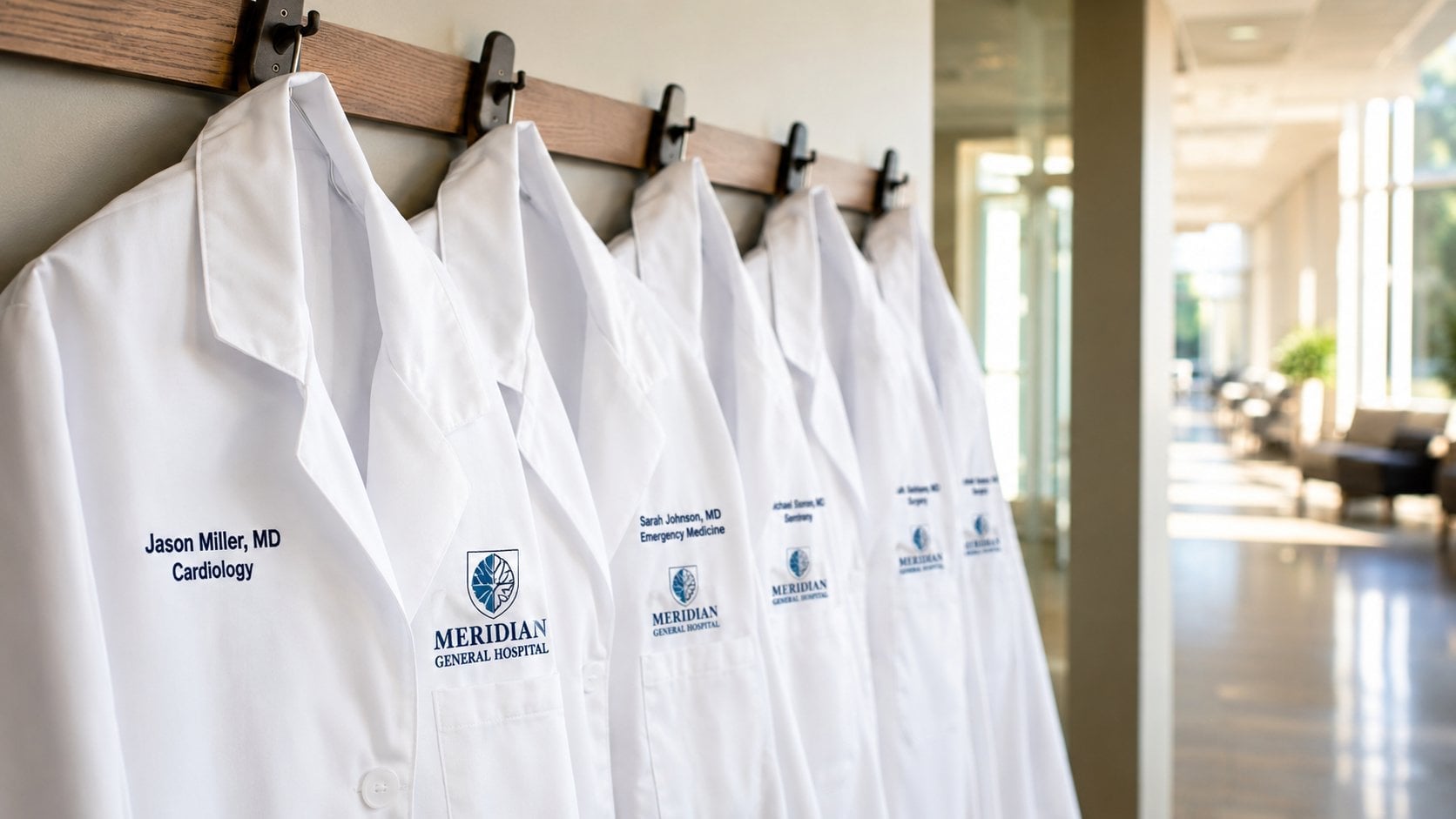
- Wash lab coats inside out, buttoned, and follow the garment care label
- Avoid chlorine bleach on colored embroidery thread; oxygen whiteners are gentler
- Treat blood and other protein stains with cool water before any heat
- Hang lab coats while slightly damp to prevent puckering around embroidery
- Reorders match your approved design, with a free mockup within 24 hours
How should you wash custom embroidered lab coats?
Custom embroidered lab coats last longest when you wash them inside out, on the care setting printed on the garment label, with a mild detergent and no chlorine bleach on colored thread. Customized Lab Coats stitches logos, names and credentials directly into the fabric, so the coat and the embroidery are cleaned together, and the gentlest routine that still meets your facility’s hygiene policy is the right one.
Start with the label. Poly-cotton and cotton lab coats tolerate different heat and handle wrinkles differently, so the manufacturer’s instructions on each coat are the first rule, not a suggestion. If your hospital, clinic or school has a laundering policy for clinical garments, that policy sits above any general advice here.
- Empty every pocket. Pens, highlighters and alcohol pads cause most ruined lab coats, not the wash itself.
- Button and turn inside out. This protects the chest embroidery from rubbing against zippers, snaps and other garments.
- Wash whites with whites. A single navy scrub top can tint a load of white lab coats grey over time.
- Skip fabric softener on embroidered areas. Heavy softener can leave a film that dulls thread sheen.
Can you use bleach on lab coats with embroidered logos?
Chlorine bleach is the most common reason embroidered lab coats lose their color. White lab coats look like obvious bleach candidates, but most logos on lab coats are stitched in colored thread, and chlorine can fade or yellow that thread long before the white fabric shows any wear. An oxygen-based whitener used per its label is usually the safer choice for keeping white lab coats bright.
If your logo is stitched in white or a very light thread, the risk is lower, but chlorine still weakens fibers with repeated use. That matters most around the collar, cuffs and pocket edges, where lab coats take the most abrasion. Rotating coats so each one is washed less often does more for brightness than stronger chemicals.
When you order through Customized Lab Coats, tell us how your team launders its coats. If a central laundry service uses strong whitening, that is useful to know when you choose thread colors at the mockup stage, because darker, saturated thread colors tend to show fading sooner than navy or black.

How do you remove ink, blood and coffee stains from lab coats?
Stains on lab coats come out most reliably when you treat them quickly, work from the back of the fabric and use cool water first. Heat sets protein stains such as blood, and a hot dryer sets nearly everything, so check that a stain is gone before the lab coat goes in the dryer. Follow your facility’s protocol for any coat with biological contamination.
| Stain | First step | What to avoid |
|---|---|---|
| Ballpoint ink | Blot from the back with rubbing alcohol on a clean cloth | Rubbing, which spreads the ink outward |
| Blood | Rinse with cold water, then an enzyme pre-treatment | Hot water or the dryer before the stain is gone |
| Coffee or tea | Rinse cool, then pre-treat with detergent | Letting it dry in overnight |
| Iodine or betadine | Rinse promptly and pre-treat before washing | Chlorine bleach on colored embroidery |
| Highlighter or marker | Blot with alcohol from the back | Washing first, which can spread the dye |
Treat around embroidery gently. Dab the stain rather than scrubbing across stitched letters, because scrubbing can raise loops in the thread. If a stain lands directly on the logo, a soft brush and patience work better than a stiff one.
Should lab coats go in the dryer or hang to dry?
Lab coats can usually go in the dryer on a low or medium setting, but hanging them while slightly damp keeps them crisper and protects embroidery better. High heat is hard on poly-cotton blends, which can pick up a shine or set-in wrinkles, and on cotton lab coats, which can shrink a little with every hot cycle.
A practical routine for busy staff is a short tumble on low heat, then onto a hanger right away. The weight of the coat pulls most wrinkles out, and the chest embroidery dries flat instead of creasing. Over-drying is what makes embroidered areas pucker, because the fabric and the thread relax at different rates.
Ironing is fine when needed. Iron the lab coat inside out, or press over the embroidery with a pressing cloth, so the stitching keeps its raised look. Never press directly on embroidered names with a hot iron face down on the front.
How many lab coats does each person need for a clean rotation?
Most staff who wear lab coats every shift are better served by more than one coat, so a clean coat is always ready while another is in the wash. Rotation is a care decision as much as a budget one: lab coats that are washed less often last longer, and nobody ends up wearing a stained coat because the only one is still drying.
The right number depends on how often your team changes coats, whether coats go home or to a central laundry, and how messy the work is. A teaching lab with occasional use needs fewer coats per person than an emergency department or a busy veterinary clinic. Our post on how many lab coats to order covers spares and staffing changes in more detail.
Because each coat in an order can carry a different name, Customized Lab Coats can produce matching pairs for every person in the same run. The minimum order is 12 lab coats in total, so a team of six with two coats each already meets it.
Which lab coat styles are easiest to keep looking new?
Poly-cotton lab coats are generally the easiest to keep looking new, because the blend resists wrinkles and holds its shape through frequent washing. Cotton lab coats feel softer and breathe well but wrinkle more and need more attention after the wash. Style matters too: shorter coats and jackets pick up fewer hem stains than full-length coats.
- Classic lab coat: the full-length standard, best for roles that want maximum coverage; plan a rotation because the longer hem sees more wear.
- Consultation lab coat: a shorter length that stays cleaner in fast-moving clinics and is quicker to press.
- Warm-up lab jacket: a cropped layer that avoids hem stains entirely and suits cold clinical areas.
- Student lab coat: built for teaching labs, where easy washing matters more than a tailored look.
- Women’s tailored lab coat: a fitted cut that benefits most from hanging to dry so the shape stays sharp.
For a deeper look at fabric choice, see our guide to poly-cotton versus cotton lab coats.
How long does embroidery last on lab coats?
Embroidery on lab coats typically lasts as long as the coat itself, because the thread is stitched through the fabric rather than applied on the surface. Faded thread usually comes from chlorine bleach or very hot cycles, and loose loops usually come from snags or scrubbing. With sensible care, the name and logo stay legible for the working life of the lab coat.
That durability is the main reason Customized Lab Coats recommends embroidery for coats that go through frequent washing. Heat-pressed decoration has its uses, but repeated hot washes and dryer cycles are harder on it, which our embroidered versus heat-pressed comparison explains.
If a loop of thread does pull loose, do not cut it flush against the fabric or pull it. Push it gently back to the inside with a blunt needle, or trim only the excess. Cutting at the surface can start a run through neighboring stitches.
When should you retire a lab coat and order replacements?
Retire a lab coat when stains no longer lift, cuffs and collars are visibly frayed, the fabric has thinned at the elbows or pockets, or the coat no longer fits the person wearing it. A worn coat undercuts the professional look the embroidered logo is meant to create, and patients notice frayed cuffs and grey whites.
Replacement is simpler when your design is already approved. Customized Lab Coats keeps the artwork and thread choices from your first order, so a reorder matches the coats your team already wears. You send the names and sizes, we confirm them on a fresh mockup within 24 hours, and production takes about 2 weeks after approval, with express shipping for tighter dates.
Many teams combine replacements with new-hire coats so each reorder clears the minimum of 12 and every coat in the building looks the same age. Our how it works page walks through the reorder steps, and you can request a quote whenever your rotation runs thin.
Frequently asked questions
Can embroidered lab coats go through an industrial or hospital laundry service?
Embroidered lab coats can usually go through an industrial or hospital laundry service, because the thread is stitched through the fabric. The main risk is strong chlorine whitening, which can fade colored thread over time. Tell Customized Lab Coats how your coats are laundered before you approve the mockup, so thread colors can be chosen with that process in mind.
Will white lab coats turn yellow over time?
White lab coats can yellow over time from body oils, detergent buildup, chlorine bleach and high dryer heat. Washing promptly after wear, using an oxygen-based whitener instead of chlorine, and drying on lower heat all help. Rotating between two or more lab coats also slows yellowing, because each coat goes through fewer wash cycles over the same working period.
How should staff store lab coats between shifts?
Lab coats keep their shape best on a sturdy hanger with broad shoulders, in a spot with some airflow. Folding a lab coat into a locker or bag creases the embroidery and the lapels. Customized Lab Coats suggests keeping clean and worn coats separate, so a coat that needs washing is never mistaken for one that is ready to wear.
Is it safe to take lab coats home to wash?
Whether lab coats can be washed at home is a policy decision for your hospital, clinic, lab or school, not something the garment decides. Many teaching and office settings allow it, while some clinical areas require central laundering. Where home washing is allowed, wash lab coats separately from household clothing and follow the care label on each coat.
What detergent works best for embroidered lab coats?
A mild liquid detergent without chlorine bleach works well for embroidered lab coats, because it cleans the fabric without stripping color from the thread. Powder detergents can leave residue in dense stitching if they do not fully dissolve. Customized Lab Coats recommends skipping heavy fabric softener on embroidered coats, since it can dull the sheen of the logo and names.
Can a lab coat with a damaged logo be repaired?
A lab coat with a small loose loop in the embroidery can often be fixed by pushing the thread back to the inside with a blunt needle. Larger damage, such as a torn pocket under a logo, is usually better solved by replacing the coat. Customized Lab Coats keeps your approved design, so a replacement lab coat matches the rest of the team.
Do poly-cotton lab coats need ironing?
Poly-cotton lab coats rarely need full ironing if they come out of the dryer promptly and go straight onto a hanger. The blend is chosen partly because it resists wrinkles. A quick press on the collar and front edges keeps lab coats looking crisp; press embroidered areas from the inside or under a cloth so the stitching stays raised.
Why do some lab coats pucker around the embroidery after washing?
Lab coats can pucker around embroidery when the fabric shrinks or relaxes at a different rate than the stitched thread, usually after very hot washes or long dryer cycles. Lower heat and hanging the coat while slightly damp prevent most puckering. A light press from the inside often flattens the area again without harming the logo or name.
Should each lab coat in an order have its own care label?
Each lab coat in an order from Customized Lab Coats arrives with the garment manufacturer's care label, which is the best guide for that specific fabric. If your order mixes styles, such as classic lab coats and warm-up lab jackets, check each label rather than assuming one routine fits all, because fabrics and recommended settings can differ.
How can a clinic keep lab coats looking consistent across the whole team?
Lab coats look consistent across a team when everyone follows one care routine, coats are replaced on a similar schedule, and reorders match the original design. Customized Lab Coats keeps your approved artwork and thread colors, so new coats match existing ones. A short care note handed out with new lab coats keeps everyone washing them the same way.
Does dark thread or light thread hold up better on lab coats?
On lab coats, dark thread such as navy or black usually hides wear and minor discoloration better than bright or pastel thread. Very saturated colors can show fading sooner if coats are washed with strong whiteners. Customized Lab Coats can show several thread options on your free mockup within 24 hours, so you can choose with your laundering routine in mind.
Get a free mockup for your lab coats
Send your logo or idea and the quantity you have in mind. Customized Lab Coats returns a free mockup within 24 hours, you approve the design before anything is produced, and standard turnaround is about two weeks with faster options available. Get a custom quote.