When a practice orders custom lab coats, most of the attention goes to the embroidery and the size chart. The two choices that quietly decide whether people actually wear the coat every day are length and fabric weight. A coat that is too long for a fast-moving nurse or too heavy for a warm pharmacy gets left on the hook, no matter how sharp the logo looks. Picking length and weight for the way your team actually works is what turns a bulk order into coats that stay on shoulders.
Length is a role decision, not a height decision
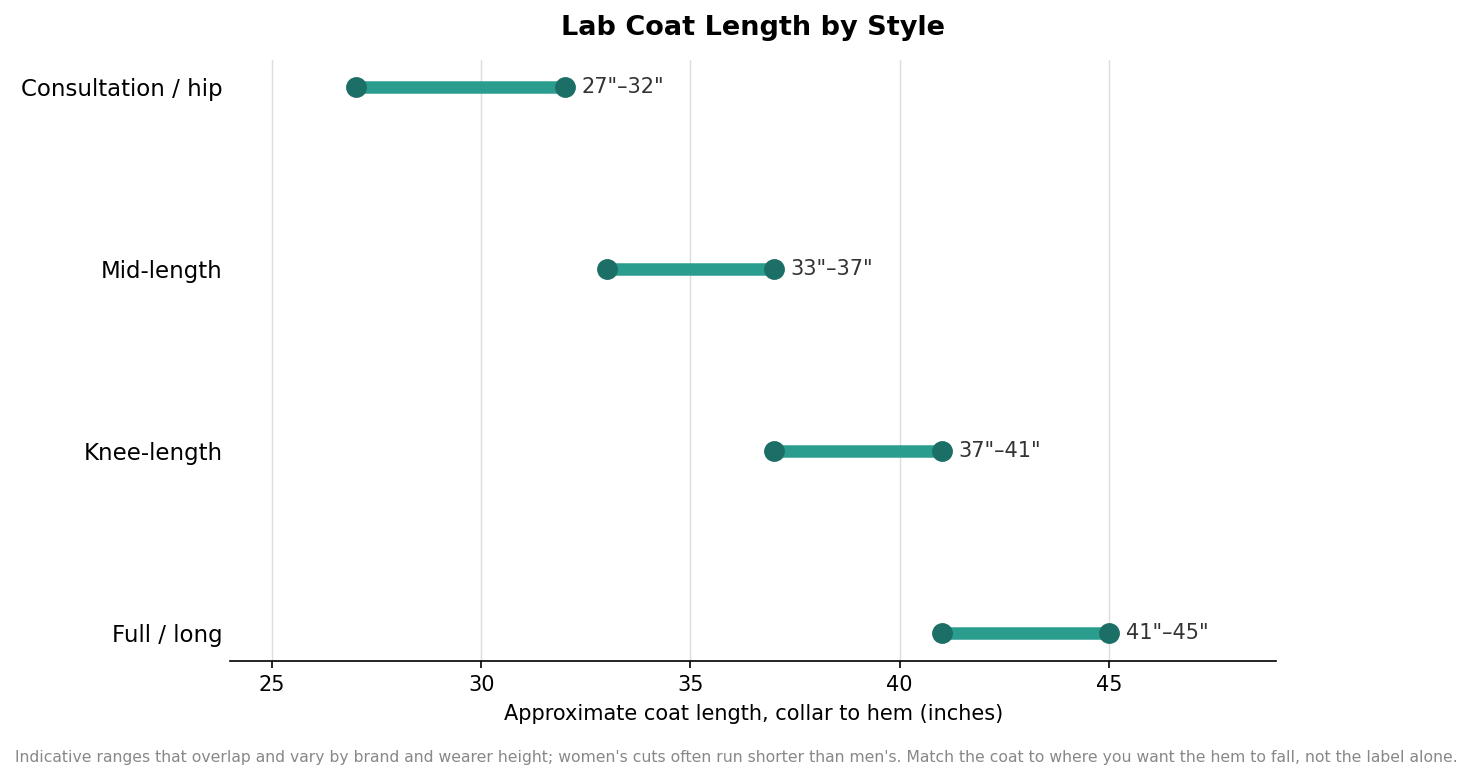
Lab coats come in a handful of length families, and while they overlap and vary by brand, they map cleanly onto how people move. A consultation or hip-length coat, roughly 27 to 32 inches from collar to hem, sits at or above the hip. It reads as modern and stays out of the way, which is why physicians doing patient consults, dentists, and med-spa staff often prefer it. A mid-length coat around 33 to 37 inches is the everyday middle ground for clinic and outpatient work, giving more coverage without catching on chairs.
Longer coats trade mobility for protection. A knee-length coat, in the region of 37 to 41 inches, is the traditional physician silhouette and the default for hospital wards and academic settings where the long white coat carries meaning. A full or long coat, 41 to 45 inches and beyond, is really a laboratory garment, chosen when the job is splash coverage over the legs at a bench rather than bedside presence. The chart below lays these ranges side by side.
Typical collar-to-hem length ranges for the main lab coat styles.
Treat those numbers as starting points that overlap in the middle. Women’s cuts frequently run a few inches shorter than men’s at the same label, and a 5-foot-2 wearer and a 6-foot-3 wearer in the same nominal length will see the hem land in very different places. The reliable approach is to decide where you want the hem to fall on a typical wearer, then match the measured length rather than trusting the style name. If you are outfitting a mixed team, ordering one length family in a full size run usually beats mixing several styles, because it keeps the look consistent and simplifies reorders.
Fabric weight sets the everyday feel
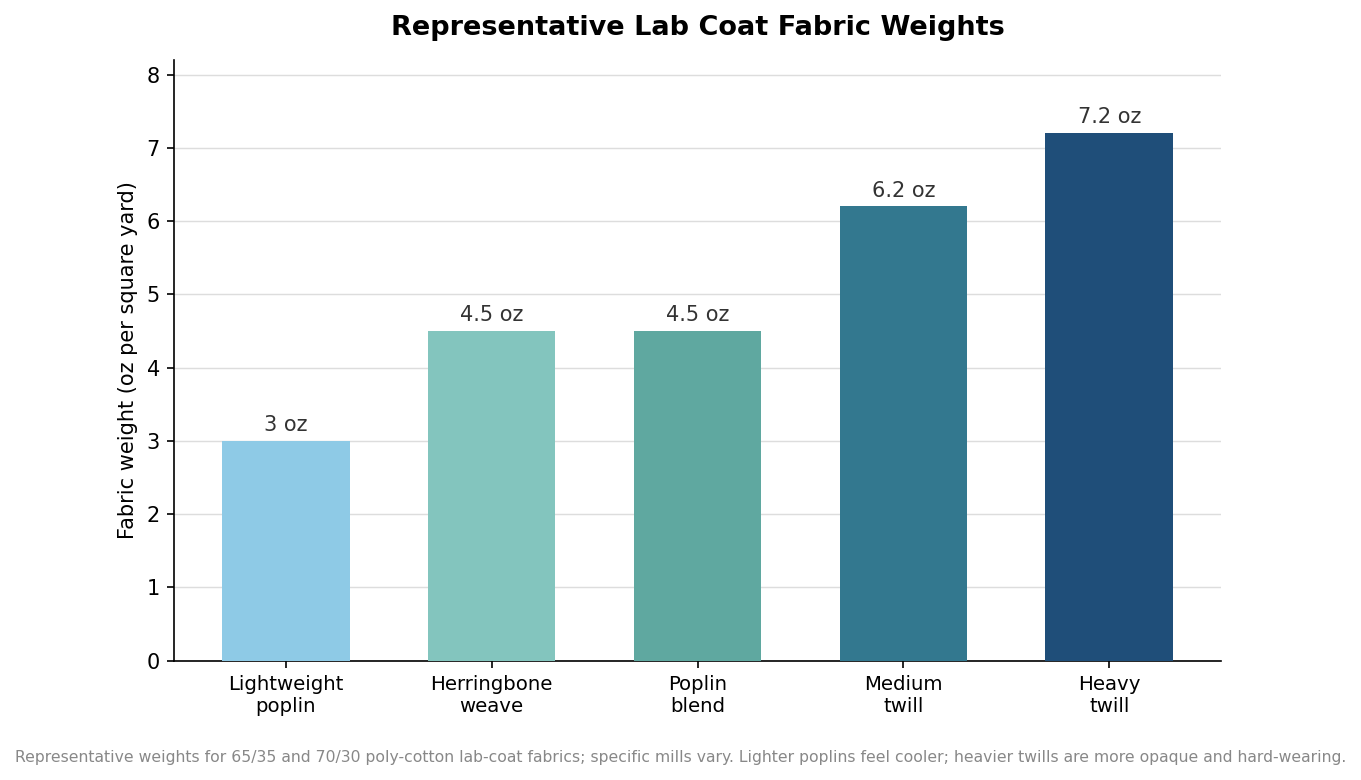
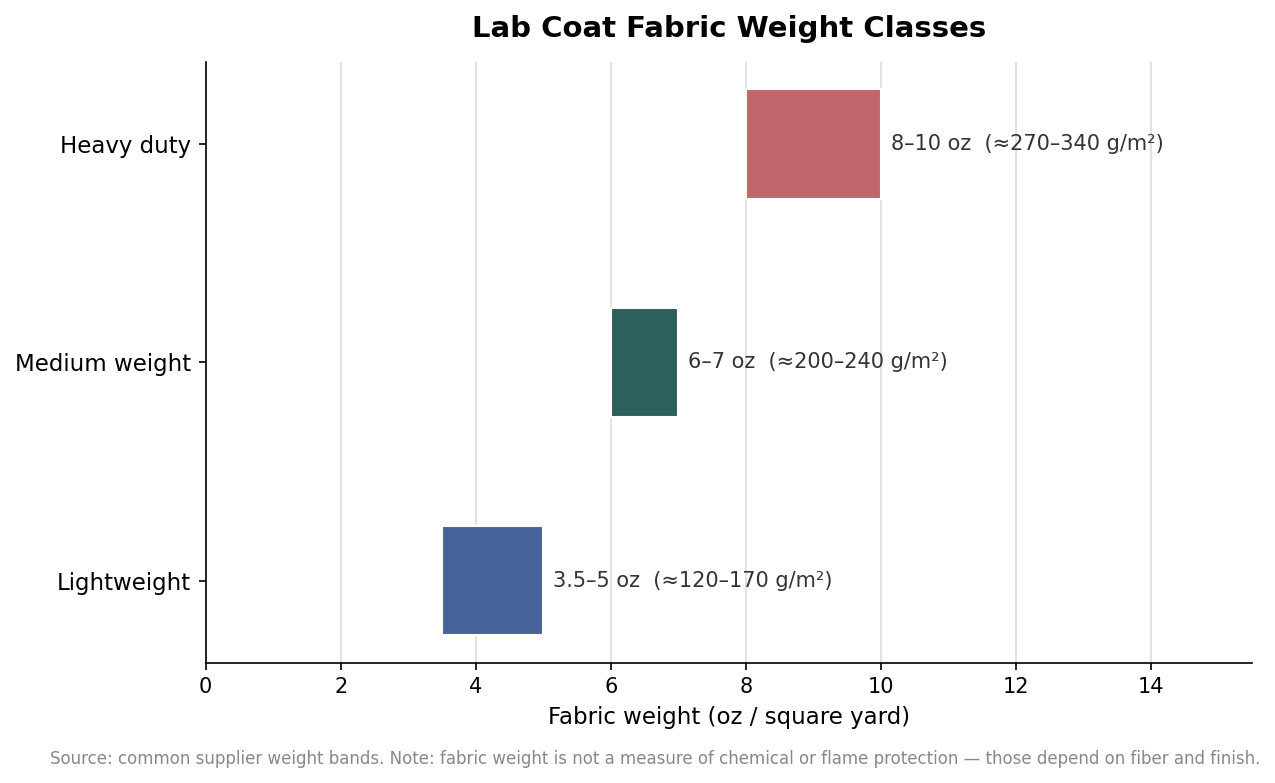
The second lever is how heavy the cloth is, measured in ounces per square yard. Lighter fabrics breathe and drape softly; heavier fabrics are more opaque, hold a crisp press, and shrug off wear and repeated laundering. Most branded lab coats today use a poly-cotton blend, commonly 65/35 or 70/30, because the polyester adds durability and wrinkle resistance while the cotton keeps some breathability. Within that family the weight range is wide, as the next chart shows.
Representative fabric weights for common poly-cotton lab coat cloths.
At the light end, a poplin around 3 ounces feels cool and is a genuine comfort upgrade in a warm pharmacy, a summer clinic, or anywhere air conditioning is scarce, at the cost of some opacity and body. A herringbone or lighter blend near 4.5 ounces splits the difference, staying comfortable while looking a little more substantial. The medium twill around 6.2 ounces is the workhorse most programs land on, crisp and professional without being hot. A heavy twill near 7.2 ounces is the most opaque and hard-wearing, well suited to coats that get worn hard and washed often, though it can feel warm for all-day desk-adjacent work.
Weight also interacts with how your branding looks. A heavier, denser twill gives embroidery a firmer foundation and tends to keep stitched logos looking clean over time, while very light poplins may need a backing to stop fine lettering from puckering. If crisp embroidery on the chest is central to your program, leaning toward a medium weight is a safe default.
Where protection changes the math
For most front-of-house medical and academic settings, length and weight are about comfort and appearance, and any professional-grade poly-cotton coat is fine. The moment real hazards enter the picture, the priorities shift. If staff handle chemicals, flammable materials, or infectious agents, the barrier and flame properties of the fabric matter more than how it drapes, and those are governed by standards rather than preference. That is a separate evaluation from the everyday comfort choices here, and it is worth reading up on barrier ratings before you commit a lab-facing team to a fabric.
In those hazard settings, coverage usually wins, which nudges you toward the longer, knee-length or full styles and often toward a snap front that can be shed quickly if something spills, along with knit cuffs that close the sleeve opening against contamination. For clean office, consult, and reception environments, comfort and a tailored look can lead, which is where the shorter lengths and lighter weights earn their place.
Putting it together for a bulk order
A practical way to specify a program is to fix three things in order: the length family that fits the role, the fabric weight that fits the environment, and only then the closures and cuffs that fit the task. A hospital ward program might settle on knee-length medium twill with a button front; a boutique dermatology office might choose hip-length herringbone for a lighter, more contemporary look; a teaching lab might specify full-length heavier twill with knit cuffs and a snap front. Each of those is a coherent set of choices rather than a single feature picked in isolation.
Because weights and lengths differ from mill to mill, request a fabric swatch and, if you can, a single sample coat in your chosen length before committing to a full run. Feeling the cloth and seeing where the hem lands on a real wearer resolves in five minutes what a spec sheet cannot, and it is far cheaper than discovering after 200 coats arrive that the fabric runs hot or the length runs long.
When people order custom lab coats, the conversation is usually about color, embroidery, and fit. Those matter, but they sit on top of a decision that matters more: whether the coat is actually rated for the hazard it will meet. A branded coat for a front-desk pharmacist and a coat for a nurse handling blood draws and a coat for a chemistry student working over an open flame are three different garments, even if they look the same in a catalog photo. Two families of standards separate them — liquid-barrier ratings for healthcare and flammability behavior for labs with heat or reactive chemicals — and a buyer who understands both can specify the right coat instead of hoping the default works.
Two risks, two standards
Fluid exposure and fire are governed by completely different systems, and a coat can be strong on one and useless on the other. In healthcare settings, liquid protection is classified under ANSI/AAMI PB70, which sorts protective apparel into four barrier levels based on standardized lab tests. In labs where flammable solvents, pyrophorics, or open flames are present, the relevant question is not a barrier level at all but what the fabric does when it meets heat — whether it resists ignition, and whether it melts. A typical branded, embroidered lab coat is a 65/35 poly-cotton in the medium weight range, which is comfortable and durable but carries no meaningful barrier rating and behaves poorly near flame. That is fine for a clinic hallway and genuinely dangerous over a Bunsen burner, so the first job is to name the real hazard before choosing a fabric.
What the AAMI PB70 levels actually mean
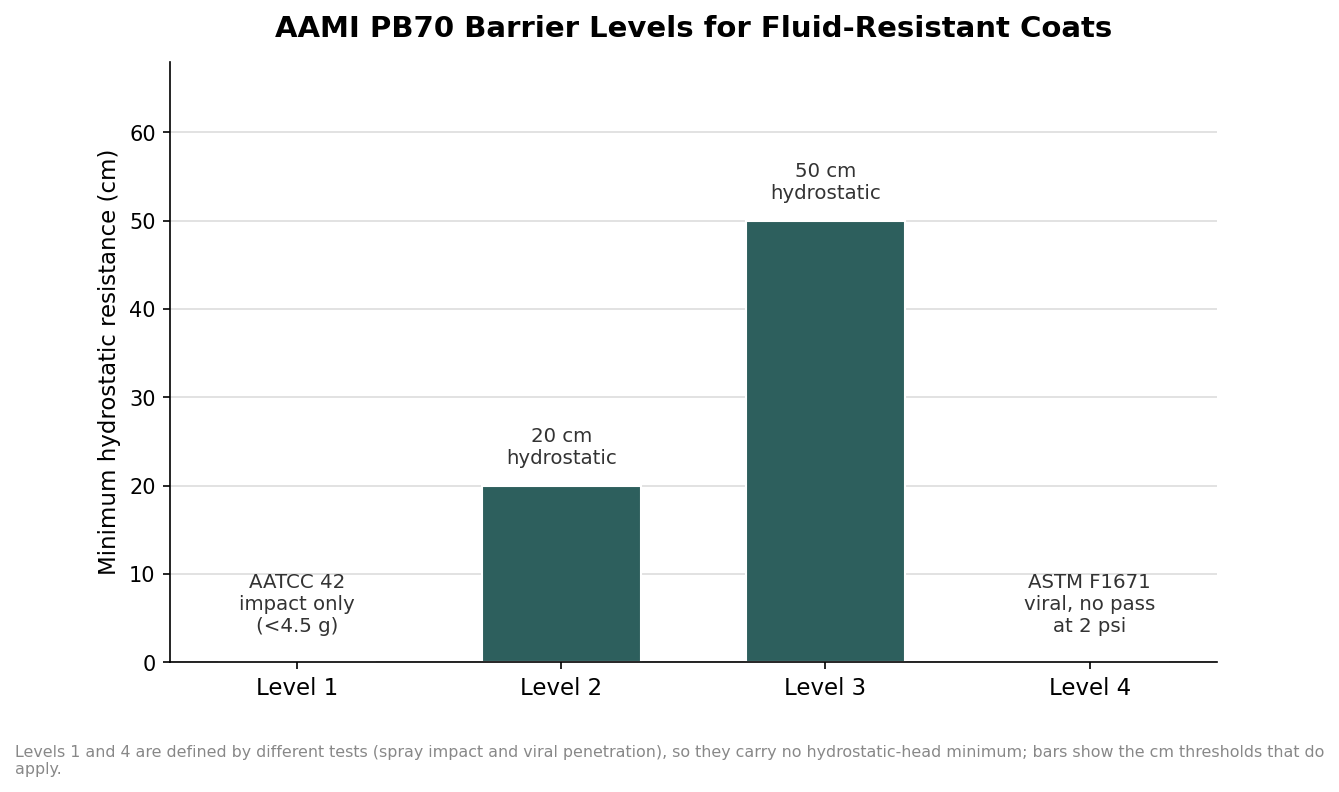
PB70 defines four levels, and each is tied to a specific test rather than a marketing adjective. Level 1 is minimal protection, evaluated with the AATCC 42 water-impact test, where a passing fabric shows only a small blotter weight gain; it suits incidental splash or spray. Level 2 adds the AATCC 127 hydrostatic-pressure test and requires the fabric to hold a water column of at least 20 cm, covering low-risk fluid contact under light pressure. Level 3 uses the same two tests but raises the hydrostatic bar to a minimum of 50 cm, for sustained liquid exposure. Level 4 is a different animal entirely: it is verified with ASTM F1671, which challenges the fabric with a bacteriophage suspension to check for viral penetration, or ASTM F1670 using synthetic blood, with no penetration permitted at 2 psi. Level 4 is the domain of surgical and isolation gowns, not everyday coats.
AAMI PB70 escalates from a simple impact test to a 50 cm hydrostatic barrier, then to viral-penetration resistance at Level 4.
The practical takeaway is that the levels are not a simple 1-to-10 scale you can eyeball. Level 2 and Level 3 differ only in how much pressure the barrier withstands, while Level 1 and Level 4 are defined by entirely separate tests. If a supplier tells you a coat is “fluid resistant,” the useful follow-up is which PB70 level and which test method, because “resists a coffee spill” and “blocks viral penetration at 2 psi” are both technically fluid resistance and are worlds apart in protection.
Matching a barrier level to the room
Choosing a level is really about matching the test scenario to the daily task. Reception, teaching, and light clinical duties rarely need more than Level 1, and often the barrier question is moot because the coat is chosen for appearance and identity rather than protection. Routine patient care with occasional fluid contact — blood draws, minor procedures, dentistry — points toward Level 2 or Level 3, where the hydrostatic threshold means a splash under some pressure will not soak through to scrubs or skin. Surgery and isolation require Level 4 garments verified against viral or blood penetration, and those are generally single-use or specially laundered rather than branded reusables. For most custom-coat programs aimed at clinics, pharmacies, and schools, the honest answer is Level 1 to Level 2, with the important caveat that a fluid-resistant finish adds cost and can wash out over time, so the coat should be re-evaluated across its laundering life rather than assumed to hold its rating forever.
Flammability: where a poly-cotton coat becomes a liability
Fabric weight tells you about durability and drape, not fire safety — a heavier coat is not a safer one near flame. What matters is fiber. Polyester melts and can fuse to skin, which is why 65/35 and 80/20 poly-cotton blends are prohibited in many academic chemistry labs with open flames, and why a 40/60 blend is only appropriate in flame-free environments. Where there are Bunsen burners, hot plates, pyrophoric compounds, or flammable solvents, the baseline is 100% cotton, which burns more slowly and does not melt. For higher exposure, flame-resistant materials step in: FR-treated cotton carries a chemical finish that resists ignition but can degrade under bleach or high-temperature laundering, while inherently flame-resistant fibers like Nomex build the protection into the fiber itself, do not wash out, and cost accordingly — commonly north of $120 per coat, with the most protective Nomex blends (roughly 93% Nomex, 5% Kevlar, 2% antistatic fiber) running over $200. One tradeoff worth naming: fire resistance and chemical resistance often pull against each other, so a fabric optimized for flame may be less ideal for certain solvent splashes, which is exactly why the hazard assessment has to come first.
Fabric weight sets durability and drape, but it does not indicate chemical or flame protection.
Specifying a custom coat without losing the protection
Once the fabric is right, customization should be designed around it rather than against it. Embroidery is generally the safe branding method on protective coats because it does not add a meltable film the way some heat-applied vinyls can, but placement still matters: logos belong on the chest and, if requested, the sleeve, away from areas where a molten transfer near a flame would be a hazard. For fluid-rated coats, remember that seams and closures are potential weak points, and that the rating applies to the fabric as tested, not automatically to a heavily modified garment. For FR coats, tell your team not to bleach them and to follow the manufacturer’s laundering guidance, because improper washing is the most common way a flame-resistant coat quietly stops being flame resistant. And because a medium-weight 6-to-7-ounce poly-cotton is the default that shows up when no one specifies otherwise, the single most valuable line in a custom order is the one that states the hazard and the required rating — Level 1 versus Level 3, standard versus 100% cotton versus inherently FR — so the coat that arrives is built for the room it will actually be worn in.
If you’ve started pricing out custom lab coats for a clinic, pharmacy team, dental office, or lab, the first thing you notice is how much the quote swings from vendor to vendor. Some sites list a coat for $9.99 and then tack on embroidery separately; others quote a single “landed” price that already includes your logo. Neither number is wrong — they’re just measuring different things, and you need to know which one you’re looking at before you compare two quotes side by side.
This guide pulls together current minimum order quantities, embroidery setup fees, fabric choices, and production timelines from several working lab coat suppliers so you can budget accurately before you request a quote. None of the figures below are estimates — they’re pulled from vendor pricing and policy pages as of August 2026.
The short version: expect to buy at least 6 to 12 coats to unlock embroidery pricing, budget $50 to $65 for a one-time logo setup, and plan for 12 to 18 business days from art approval to shipment on a made-to-order run.
6 pieces
Lowest embroidery minimum order (RushOrderTees)
12 pieces
Typical MOQ for a full custom lab coat program (AllStarLogo)
Made-to-order production plus personalization lead time (JustLabCoats)
Source: RushOrderTees, AllStarLogo, Blue Sky Scrubs and JustLabCoats vendor pricing and policy pages, checked August 2026
What custom lab coats actually cost
Blank, uncustomized lab coats start as low as $9.99 at volume retailers like JustLabCoats, but that price almost never survives contact with a logo. Once you add embroidery, you’re paying for three separate things: the coat itself, a one-time setup charge to digitize your logo into a stitch file, and a per-unit embroidery run charge that applies every time the design is stitched onto a coat.
Those per-coat charges add up fast at low quantities and shrink just as fast once you cross a volume threshold. Rx Minuteman Press, for example, quotes a single embroidered lab coat with a logo above the left chest pocket and a name on the right chest at $117.24 for one unit — but the identical coat drops to $67.24 each once you order five at a time. That’s not a rounding-error discount; it’s a 43% swing driven almost entirely by spreading the fixed setup cost across more units.
Custom lab coats follow the same economics as any embroidered apparel: the setup fee is fixed, so the more coats you put it on, the less it costs per coat. If your first order is a single sample coat for approval, expect to pay a premium for it — then re-quote once you know your real headcount.
Per-coat price falls 43% when an embroidered lab coat order grows from 1 unit to 5 units.Source: Rx Minuteman Press lab coat order pricing page (rxminutemanpress.com), checked August 2026
Minimum order quantities for custom lab coats
MOQs vary more by vendor than by product. If you only need a handful of coats — say, for a small dental practice or a single lab team — RushOrderTees runs one of the lowest floors in the category, with an embroidery minimum of just six pieces. That’s enough to outfit a small team without ordering coats you don’t need.
Move up to a full branded program and 12 pieces becomes the more common threshold. AllStarLogo’s full-length lab coat program is built around a 12-piece minimum, with an embroidered logo (up to 8,000 stitches, up to six thread colors) included in that base price alongside a one-time $65 setup fee. Once you’re past the minimum, most vendors price in per-unit tiers rather than a flat rate, so a 25-coat order and a 100-coat order won’t scale linearly — get a quote at your actual target quantity rather than extrapolating from a smaller tier.
A few suppliers, including PROMOXWEAR and WearForm, advertise no minimum at all for embroidered lab coats, which is worth knowing if you need to replace one coat for a new hire without re-ordering for the whole department. Expect the per-unit price on a one-off order to run noticeably higher than it would inside a 12-plus piece batch, though.
Embroidery vs. screen printing setup costs
Embroidery is the default for custom lab coats — it holds up to repeated industrial laundering far better than screen printing, which matters for a garment that gets washed weekly. That durability comes with an upfront cost: a one-time digitizing fee to convert your logo into a stitch file the embroidery machine can read. Blue Sky Scrubs charges a flat $50 for this; AllStarLogo bundles a comparable $65 setup into its coat pricing. Either way, budget for it as a one-time cost against your first order, not a per-coat charge.
Beyond the logo itself, most suppliers price name and title embroidery separately. JustLabCoats, for instance, charges $8.95 to add a logo and $7.95 per line for a name or title — so a coat with a logo, a name, and a credential line (say, “Dr. Jane Smith, DDS”) adds roughly $24 in personalization on top of the base coat price. If you’re outfitting a team where every coat needs a different name, multiply that per-line charge by headcount rather than assuming it’s included in your quoted unit price.
Screen printing is occasionally offered as a lower-cost alternative for large logos or full-back designs, but it’s uncommon on lab coats specifically — the fabric weights and finishes used for lab coats tend to favor embroidery or heat-transfer vinyl for small runs.
Fabric and material options
Most custom lab coats on the market are cut from a 65/35 polyester-cotton blend — a compromise fabric that resists wrinkling and holds up to frequent washing better than 100% cotton, while staying more breathable than heavier twill. You’ll see this blend by name across multiple suppliers, including Great Lakes Uniform’s men’s and women’s lab coat lines and The Lab Stockroom’s snap-front and ribbed-cuff styles.
If your team prefers natural fiber, 100% cotton lab coats are still widely available — JustLabCoats carries a dedicated cotton line — but cotton wrinkles more and tends to need more frequent pressing between shifts. Some suppliers also offer a poplin weave as a lighter, dressier alternative to twill for coats worn in patient-facing or client-facing settings rather than a working lab.
Fit and closure style matter as much as fabric when you’re ordering for a mixed team: confirm whether the coat is offered in true unisex sizing or separate men’s and women’s cuts, and whether the front closes with buttons or snaps, before you lock in a size run across 12 or more people.
Lead times: how long custom lab coats take to ship
Made-to-order custom lab coats are not a next-day product. JustLabCoats quotes 10 to 15 business days in production before an order ships, plus another 2 to 3 business days for personalization work like embroidery — call it 12 to 18 business days total from order confirmation to the truck leaving the warehouse. That’s roughly two and a half to three and a half weeks before shipping transit time is even added.
That timeline is driven by two things: garment production (cutting and sewing the coats themselves, if they’re not already sitting in stock in your sizes) and the embroidery queue, which runs separately once your logo is digitized and approved. If your supplier already stocks blank coats in your sizes, you can often skip the production step entirely and go straight to embroidery, which shortens the timeline considerably — worth asking about directly when you request a quote.
Build in slack for approval cycles. A digital proof typically needs sign-off before stitching starts, and every round of revisions to logo placement, thread color, or name spelling adds a day or two. If you’re ordering for a launch date — a new hire’s start date, a practice opening, a conference — submit your order at least four weeks out to leave room for one revision round and standard ground shipping.
How to order custom lab coats without overpaying
Start by nailing down your real headcount and size breakdown before you request a quote — vendors price in tiers, so knowing whether you need 11 coats or 13 can change which pricing bracket you land in. Ask every supplier for the same three numbers up front: the base coat price at your quantity, the one-time logo setup fee, and the per-line name/title embroidery charge if you need individual names.
Order one sample coat first if the vendor allows it, even at the higher one-off price, so you can check fabric weight, sizing, and embroidery quality before committing to a full batch. The premium you pay on that single sample is small compared to the cost of re-ordering an entire team’s coats because the fit runs small or the thread color is off.
Finally, confirm turnaround in writing against your actual need-by date, not the vendor’s advertised minimum. “10-15 business days in production” plus personalization time plus shipping adds up quickly, and rush production — when it’s offered at all — usually carries its own surcharge.
Questions to ask before you pay a deposit
Confirm whether the quoted price already includes the logo setup fee or adds it separately, whether name/title embroidery is priced per line or per coat, and whether the lead time quoted starts at order confirmation or at art approval — those two dates can be a week apart if your logo needs revisions.
Frequently asked questions
What is the minimum order quantity for custom lab coats?
It depends on the supplier. Some run embroidery minimums as low as 6 pieces, while a full branded lab coat program more commonly starts at 12 pieces. A few suppliers advertise no minimum at all, but expect a higher per-unit price on very small orders.
How much does it cost to add a logo to a lab coat?
Expect a one-time digitizing/setup fee in the $50–$65 range to convert your logo into an embroidery file, plus a per-coat embroidery charge. Adding a name or title separately typically runs about $7.95–$8.95 per line, billed per coat.
How long does it take to get custom lab coats made?
Made-to-order lab coats generally take 10–15 business days in production, plus another 2–3 business days for personalization — roughly 12–18 business days total before shipping. Add transit time and any proof-approval delays on top of that.
What fabric is best for a custom lab coat?
A 65/35 polyester-cotton blend is the industry standard because it resists wrinkling and holds up to frequent washing. 100% cotton is available for teams that prefer natural fiber, though it wrinkles more; poplin offers a lighter, dressier alternative for patient-facing roles.
Is embroidery or screen printing better for lab coats?
Embroidery is the standard choice for lab coats because it withstands repeated industrial laundering far better than screen printing. Screen printing shows up occasionally for large or full-back designs, but most lab coat suppliers are set up for embroidery or heat-transfer vinyl on smaller runs.
Does ordering more lab coats actually save money?
Yes, meaningfully. In one supplier’s published pricing, an embroidered lab coat with a logo and name dropped from $117.24 for a single unit to $67.24 each at five units — a 43% reduction — because the fixed logo setup cost gets spread across more coats.
The bottom line
The numbers above should give you a realistic budget range before you ever fill out a quote form: a 6- to 12-piece minimum, a $50–$65 logo setup fee, per-line charges for names, and a 12- to 18-business-day production window. Where suppliers differ most is in how they bundle those costs into the headline price, so ask for an itemized quote rather than a single per-coat number — it’s the only way to compare offers accurately. Once you know your headcount, sizes, and need-by date, get a written quote and lock in your order with enough lead time to allow for one round of proof revisions.
How to Choose Custom Lab Coats for Your Brand: Use Cases and Ordering
The best way to choose custom lab coats is to start from how they will be used, then work back to the material, size, and decoration that fit. Custom lab coats serve very different jobs across teams & uniforms, events & promotions, hospitality & retail, and clubs & organizations, and matching the order to the job is what makes custom lab coats feel purpose-built rather than generic. This guide maps the common use cases and walks through ordering custom lab coats that fit your brand.
Whether the lab coats protects a product, presents a gift, or carries a logo into the world, defining that job first keeps every later decision easy. Purpose drives the spec, and the spec drives the result.
How organizations use custom lab coats
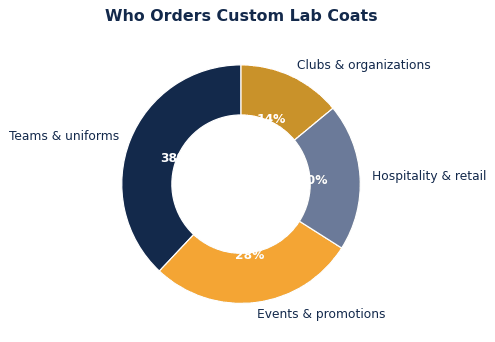
Custom lab coats get ordered for a mix of protection, presentation, and promotion, and knowing where yours fall points you to the right build. The breakdown below shows the common uses, from teams & uniforms to clubs & organizations.
The common ways organizations put custom lab coats to work.
Most orders lean toward one primary job with a secondary benefit — a shipping-focused lab coats that also brands the unboxing, or a gift-focused one that also protects. Naming your primary use keeps the order focused and the spec appropriate.
Use case
What it needs
Teams & uniforms
a consistent, branded look across a group
Events & promotions
wearable branding attendees keep
Hospitality & retail
staff apparel that reinforces the brand
Clubs & organizations
identity pieces members wear with pride
Matching material and size to the use
Once the use is clear, the material and size follow. A protection-first job favors a durable, well-fitted build; a presentation-first job favors a premium material and a clean print; a promotion-first job favors a cost-effective option you can order in volume. Sizing to the product with a small margin keeps the lab coats looking intentional and performing its job.
If a single order serves more than one use, spec to the most demanding one so the lab coats performs everywhere. It is easier to use a slightly sturdier or more premium lab coats across the board than to discover a bargain option falls short for your most important use case.
Branding for the impression you want
Decoration should reinforce the impression the use calls for. Screen printing suits bold logos at volume, embroidery adds a durable premium look, and heat transfer handles detailed full-color art. For a premium or gift use, lean on finishes and restraint; for high-volume promotion, prioritize a bold, legible logo that reads at a glance and reproduces affordably at scale. Keep branding consistent with the rest of your packaging or merch so everything reads as one system.
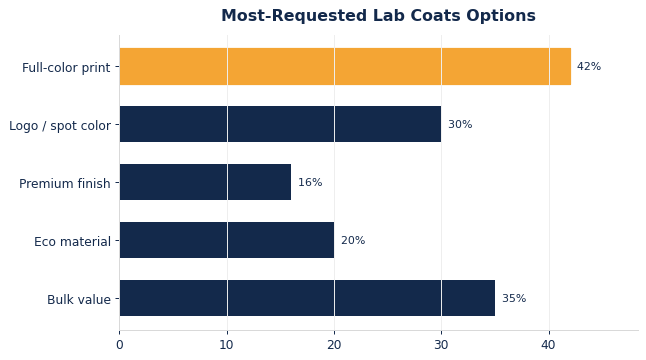
The most-requested options below reflect what buyers reach for most, and they are a useful starting menu when you brief your order. Whatever you choose, approve a proof so the finished custom lab coats match the impression you intended.
The options buyers request most on custom lab coats.
Getting the size and details right
Even with the use and material decided, the details are what make custom lab coats feel finished. Confirm the size range against the product with a small margin, check the print area for your chosen size so the logo sits cleanly, and decide on any finishing touches before you brief the order. These small confirmations up front are what separate a lab coats that looks intentional from one that looks close-enough.
A sample or proof is the cheapest insurance you can buy on a lab coats order. A physical sample lets you judge the material and print in hand, while a digital proof confirms artwork, color, and size range before the full run. Spending a few minutes here prevents the far larger cost of reworking a finished order of custom lab coats that missed on a detail.
Ordering: quantities, lead time, and reorders
A smooth lab coats order comes down to a few basics: order for real demand plus a small overage, send print-ready artwork early, and confirm lead time against any deadline so production and shipping fit your timeline. Per-unit cost drops with volume, so consolidating a season’s needs into one run is usually more efficient than repeated small orders.
Keep your approved artwork and spec on file so reorders are a quick repeat rather than a fresh setup each time — consistency across runs keeps your brand looking deliberate.
Coordinating with the rest of your brand
Custom lab coats rarely stand alone; they sit alongside your other packaging, print, or merch, so coordinating them strengthens the whole brand. Carrying the same logo, colors, and tone across your lab coats and your other pieces makes everything read as one deliberate system rather than a set of one-off orders. That consistency is what makes a brand feel established, and it costs nothing extra to plan.
Coordination also simplifies buying over time. Standardizing on a material, size, and decoration you are happy with turns future orders into simple repeats, and it keeps every batch matching the last. A little upfront alignment pays back every time you reorder custom lab coats.
Frequently asked questions about custom lab coats
What are custom lab coats used for?
Custom lab coats serve a mix of protection, presentation, and promotion across teams & uniforms, events & promotions, hospitality & retail, and clubs & organizations. Most orders lean toward one primary job with a secondary benefit, so naming your main use is the first step in speccing the right lab coats.
How do I match custom lab coats to my use?
Let the use drive the spec: durable and well-fitted for protection, premium and clean for presentation, cost-effective and bold for promotion. If one order serves several uses, spec to the most demanding one so the lab coats performs everywhere.
How should I brand custom lab coats?
Screen printing suits bold logos at volume, embroidery adds a durable premium look, and heat transfer handles detailed full-color art. Choose finishes and restraint for premium or gift uses, and a bold, legible logo for high-volume promotion, keeping the branding consistent with your other packaging or merch so it all reads as one system.
How far ahead should I order custom lab coats?
Order for real demand plus a small overage, send print-ready artwork early, and confirm lead time against any deadline so production and shipping fit your timeline. Consolidating a season’s needs into one run is usually more efficient than repeated small orders.
Can I reorder easily?
Yes. Keeping your approved artwork and spec on file makes reorders a quick repeat rather than a fresh setup, and it keeps every batch of custom lab coats matching the last for a consistent brand look.
Do I need a sample before ordering custom lab coats?
A sample is worth it for a first order or a new material, since judging feel and print in hand removes the guesswork. For a straightforward reorder of custom lab coats you have bought before, a digital proof confirming artwork and size range is usually enough.
Match the lab coats to the job, spec it deliberately, and approve a proof, and your order will do exactly what you needed. For the full material and sizing breakdown, see our companion guide, our Custom Lab Coats: Materials, Sizing & Branding Guide, and browse our our shop to get started.
Not sure which custom lab coats fit your use?
Tell us how you’ll use them and we’ll match the material, size, and branding to the job.
Custom Lab Coats: A Materials, Sizing, and Branding Guide
Getting custom lab coats right comes down to three decisions: the material, the size or spec, and how you brand them. Make those well and you end up with custom lab coats that protect and present your product, reinforce your brand, and land on budget. This guide walks through the material options, how to size and spec your order, and how to decorate custom lab coats so they do real work for your brand rather than just checking a box.
Whether you are ordering your first run or reordering at scale, the same fundamentals apply. Choosing custom lab coats deliberately — material to job, size to product, decoration to brand — is what separates an order you are proud of from one you settle for.
Why custom lab coats matter for your brand
Custom lab coats are more than a commodity; they are a touchpoint organizations experience directly. A well-chosen, well-branded option signals quality and attention to detail, while a generic one quietly undercuts an otherwise strong product. Because custom lab coats are seen and handled, they carry your brand into the world every time they are used.
That visibility is exactly why it pays to spec custom lab coats intentionally. The material sets the feel, the size sets the fit and cost, and the decoration sets the impression — and getting all three aligned turns a functional item into a genuine brand asset.
Materials and options compared
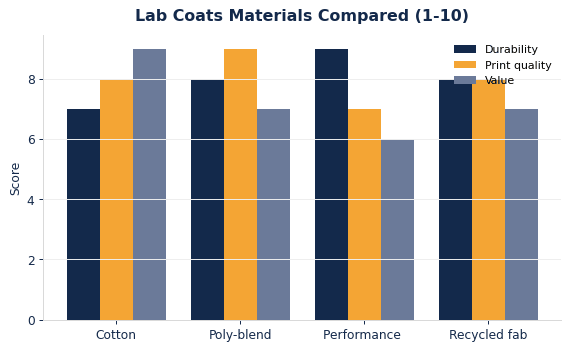
The common materials for custom lab coats each trade off durability, print quality, and cost: cotton, poly-blend, performance fabric, and recycled fabric. The right pick depends on how the lab coats will be used, the look you want, and your budget. The chart and table below compare the main options so you can match material to job.
How common lab coats materials compare on durability, print quality, and value.
As a rule of thumb, choose a recyclable or natural material when eco positioning matters, a coated or laminated option when you want vivid full-color print, and a premium build when the lab coats is part of a gift or high-end presentation. When in doubt, request a sample so you can judge feel and print before committing to a full run.
Material / option
Best for
Cotton
soft, breathable, and easy to decorate
Poly-blend
durable, wrinkle-resistant, colorfast
Performance fabric
moisture-wicking for active use
Recycled fabric
sustainable option with a modern story
Sizing and specs
Sizing is where many lab coats orders go wrong, so measure before you order. Custom lab coats typically range from a full youth-to-adult size run for consistent team fit, and the right size range depends on the product or use they serve. Too small and the fit is tight or the product is exposed; too large and you pay for material you do not need and lose a clean, intentional look.
When a measurement falls between standard options, size to the product with a small margin rather than guessing. Confirming the size range on a proof or sample before a large run prevents the costly mistake of a full order that does not fit, which is far more expensive to fix than a five-minute check up front.
Branding and decoration
Decoration is what turns a plain lab coats into a branded one. Screen printing suits bold logos at volume, embroidery adds a durable premium look, and heat transfer handles detailed full-color art. Match the method to your artwork and budget: simple logos reproduce cleanly and cheaply, while detailed, full-color designs shine with the right process on the right material. Keep the artwork vector where possible and confirm the print area for your chosen size.
Restraint usually reads as premium. A clean logo, one or two brand colors, and quality material almost always look more considered than a busy, over-printed design. Approving a proof before the run protects both the look and the budget, especially on a large order of custom lab coats.
Ordering and budget
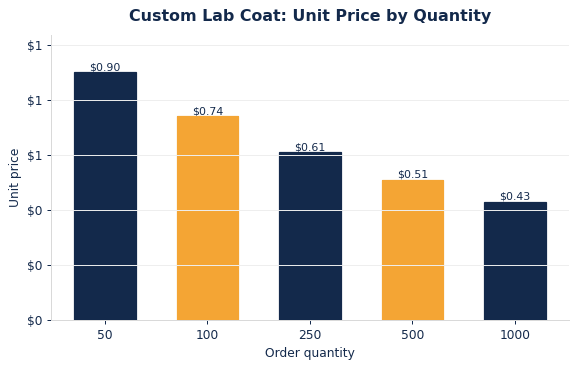
Per-unit cost on custom lab coats falls steadily with volume as setup amortizes across more pieces, so ordering for real demand rather than a token first batch is usually the efficient move. The curve below shows how pricing typically improves with quantity, which helps you plan an order that balances cash and cost.
Typical per-unit lab coats pricing as order quantity increases.
Ordering for a recurring need? A single larger run lowers the unit cost and keeps your branding consistent, while a small overage covers reorders and the occasional damaged piece without a rush order.
Common mistakes to avoid
A few avoidable missteps account for most disappointing lab coats orders. Ordering before measuring is the biggest, followed by choosing a material for price alone without considering how the lab coats will actually be used, and skipping the proof on a large run. Each is easy to prevent with a few minutes of planning, and each is expensive to fix once a full order is produced.
The other common trap is over-designing the artwork. Cramming in too many colors, effects, or details can muddy the print and raise the cost, especially on textured or recycled materials. Simplifying the design to a clean, legible mark almost always improves both the look and the price of your custom lab coats.
Frequently asked questions about custom lab coats
What material is best for custom lab coats?
It depends on the use: choose a recyclable or natural material for eco positioning, a coated or laminated option for vivid full-color print, and a premium build for gifting or high-end presentation. Request a sample to judge feel and print before a full run of custom lab coats.
How do I choose the right size?
Measure the product or use the lab coats serves, then size to it with a small margin so the fit is clean without wasting material. When a measurement falls between standard options, size up slightly and confirm the size range on a proof before ordering in volume.
How are custom lab coats branded?
Screen printing suits bold logos at volume, embroidery adds a durable premium look, and heat transfer handles detailed full-color art. Match the method to your artwork and budget, keep the art vector where possible, confirm the print area for your size, and approve a proof so the finished custom lab coats match your intent.
How does pricing work, and is there a minimum?
Per-unit cost drops with quantity as setup amortizes across the run, so larger orders are more cost-effective. Order for real demand plus a small overage rather than a token batch, and consolidate recurring needs into one run for the best price.
Can I get a sample or proof before ordering?
Yes, and it is strongly recommended. A physical sample lets you judge material and print, and a digital or physical proof confirms your artwork, color, and size range before a full run — a small step that prevents a costly mistake on a large order.
What do you need to quote custom lab coats?
To quote accurately we need the size range or the product they serve, the quantity, your material preference, and your artwork or a description of the branding. With those details we can recommend the right material and size and give you pricing for the run, and a proof follows once the order is confirmed.
Whatever you order, send vector artwork, confirm material and size range, and approve a proof before production. For help matching custom lab coats to a specific use, see our companion guide, our How to Choose Custom Lab Coats for Your Brand, and explore our our shop to start your order.
Ready to order custom lab coats?
Tell us your product, quantity, and branding and we’ll match the material, size, and decoration for you.
Home › Blog › How Many Lab Coats Should You Order?
Ordering
How Many Lab Coats Should You Order?
06/12/2026
Deciding how many custom lab coats to order is the first practical question every buyer hits, and getting it roughly right saves both money and a mid-year scramble. Order too few and staff are short a coat during laundering; order too many and unused coats sit in a supply closet tying up budget that could go elsewhere.
Here is the practical framework we walk hospitals, clinics, pharmacies, schools, and wellness programs through when sizing an order.
Start with headcount, not a round number
The cleanest starting point is your actual staff or student headcount who will wear the coat — not a round number that sounds convenient. Count every role that wears a coat: physicians, nurses, technicians, pharmacists, front-desk staff, students, or program participants, depending on your setting.
Add a laundry-rotation buffer
Coats worn daily and laundered frequently need more than a one-per-person count. A common rule of thumb is 1.5 to 2 coats per person for daily-wear clinical roles, so staff always have a clean coat while another is in the wash. Lower-frequency wearers — occasional clinical visitors, part-time staff, or wellness program participants who wear a coat a few times a month — can typically get by on one coat each.
Factor in new hires and turnover
If your organization hires or turns over staff regularly, add a modest buffer — typically 10 to 15 percent of your base order — so new hires can be outfitted without triggering a whole new production run for a handful of coats. This buffer also covers the occasional damaged or lost coat.
Quantity guidance by scenario
Scenario
Typical quantity
Best style
Single small practice or pharmacy
25–50
Classic or Consultation coat
Medical or nursing school cohort
30–250
Student Lab Coat
Hospital department
50–200
Classic Full-Length
Full hospital system
500–2,000+
Mixed styles by department
Corporate wellness program
25–150
Warm-Up Lab Jacket
Veterinary practice
25–60
Consultation (Short)
Choosing for your order
When your calculated quantity lands close to the next price break, it is almost always worth rounding up — the per-unit cost typically drops enough at the next tier that the extra coats cost very little in real terms, and any surplus covers next year’s new hires without a second production run. Since our minimum order is just 12 units, even a single department or a small independent practice can order a properly sized, professionally decorated batch without over-committing.
Key takeawayPlan on 1.5–2 coats per person for daily-wear clinical roles, add a 10–15% buffer for new hires and turnover, and round up to the next price break when you are close.
Poly-Cotton vs. 100% Cotton Lab Coats: Choosing the Right Fabric
06/05/2026
Fabric choice gets less attention than logo placement or decoration method, but it drives more of a lab coat’s real-world performance than almost anything else — how it holds up to industrial laundering, how it wears across an eight-hour shift, and how crisp the embroidery looks after year one. We offer two core fabric families: poly-cotton twill and premium cotton-blend. Here is how to choose between them.
Both fabrics take embroidery and heat-pressed decoration well; the difference is in day-to-day performance and long-term cost per wear.
Poly-cotton twill: the durability default
Poly-cotton twill blends polyester with cotton, which gives it strong wrinkle resistance, a crisp finish straight out of the dryer, and excellent dimensional stability through repeated hot-water and high-heat industrial laundering. It is the fabric we recommend by default for hospital, clinic, and pharmacy programs where coats are washed frequently and need to look sharp with minimal ironing.
Premium cotton-blend: comfort for long shifts
Premium cotton-blend fabric leans more heavily toward natural cotton fiber, trading a bit of wrinkle resistance for a softer hand and better breathability. Staff who wear a coat for a full shift, especially in warmer environments or under additional layers, often notice and prefer the difference. It is a common upgrade choice for physician and senior staff coats where comfort and feel carry a bit more weight than in a high-turnover student or technician program.
Both fabrics take embroidery cleanly, but the tighter weave of poly-cotton twill gives stitching a slightly crisper, more defined edge, which matters for detailed logos or small text like a nameplate. Premium cotton-blend has a softer surface that some buyers feel gives embroidery a more natural, less “stiff” look — a matter of preference more than a durability difference.
Cost per wear
Poly-cotton twill typically sits at the lower end of our per-unit pricing range at the 12-unit minimum, while premium cotton-blend runs toward the higher end given the material cost. Over a coat’s full usable life, though, cost per wear tends to even out: poly-cotton’s durability stretches its usable life through more wash cycles, while premium cotton-blend’s comfort often means staff simply prefer wearing it, which is its own kind of value.
Choosing for your order
Choose poly-cotton twill as your default for high-frequency laundering programs — hospitals, clinics, pharmacies, and student cohorts. Choose premium cotton-blend when comfort over a long shift is the priority and coats are laundered on a more moderate schedule. If you are outfitting a mixed team, it is common to order poly-cotton twill for general staff and premium cotton-blend for physician or senior-level coats.
Key takeawayPoly-cotton twill wins on durability and wrinkle resistance for heavily laundered programs. Premium cotton-blend wins on shift-long comfort where laundering is less frequent.
Not sure which fabric fits your program? Get a custom quote — free mockups in 24 hours, and we will recommend a fabric based on your wash schedule. Learn more about how we work, or browse more guides.
Home › Blog › A Pharmacy's Guide to Branded Lab Coat Programs
Pharmacies
A Pharmacy's Guide to Branded Lab Coat Programs
05/22/2026
A pharmacist’s lab coat is one of the few pieces of branding a customer sees up close, at the counter, during a conversation about their own health. For independent pharmacies competing against national chains, and for multi-location groups trying to look consistent across every storefront, a well-run coat program is a small investment that pays back in trust and in fewer re-order headaches down the line.
Here is how pharmacies typically approach a branded lab coat program, from a single independent location to a regional chain.
Why the coat matters at the counter
Patients associate a clean, professional, clearly-branded coat with competence — it is a visual shortcut for “this pharmacy is legitimate and organized.” An embroidered pharmacy name and pharmacist’s name on the coat also personalizes the interaction, which independent pharmacies can use as a genuine differentiator against the more anonymous experience at a big-box chain counter.
A single-location independent pharmacy typically starts at or near our 12-unit minimum — enough to cover pharmacists and pharmacy technicians with a couple of spares for laundering rotation. The goal at this stage is less about volume and more about locking in consistent artwork (logo placement, thread colors, nameplate format) so every future re-order matches exactly, even years later.
Multi-location groups: standardize once, order many times
Pharmacy groups running multiple storefronts benefit most from standardizing the coat spec once — same fabric, same logo placement, same color options — then letting individual locations re-order against that spec without re-designing anything. This cuts the friction that usually slows down multi-location ordering: a new store manager can request coats for their location using the exact same file we have on record, with no design back-and-forth.
Order sizing by pharmacy type
Pharmacy type
Typical order size
Reorder cadence
Single independent location
25–40 coats
Annually or as staff turns over
Small regional group (3–8 locations)
25–50 coats per location
Rolling, per-location as needed
Larger pharmacy chain
100–500+ coats
Scheduled bulk re-orders
Fabric and decoration choices for pharmacy settings
Pharmacy staff wear coats for full shifts on their feet, so comfort matters as much as durability. Poly-cotton twill is the common default for its wrinkle resistance and clean embroidery hold; premium cotton-blend fabric is worth the upgrade for staff who prioritize a softer hand over a full shift. Embroidery remains the standard decoration for pharmacy coats given the regular laundering schedule most pharmacies keep — heat-pressed decoration is a reasonable lower-cost option for seasonal or part-time staff coats that see less wear.
Choosing for your order
Start with a consistent artwork spec even on a first small order — it is what makes every future re-order effortless. Independent pharmacies should expect to land near our 12-unit minimum for a first order; multi-location groups benefit most from locking the spec once and letting each location re-order independently against it.
Key takeawayLock in your artwork and fabric spec on the first order, even if it is small — it is what makes every future re-order, at any location, fast and consistent.
Home › Blog › Custom Lab Coats for Hospitals & Clinics
Hospitals
Custom Lab Coats for Hospitals & Clinics
05/08/2026
Walk into any well-run hospital or multi-site clinic group and the staff coats tell you something before anyone speaks: department, role, sometimes seniority — all embroidered clearly enough to read from a few feet away. For patients navigating an unfamiliar building, that visual clarity builds trust fast. For the organization, a standardized coat program is also a quiet piece of internal operations, making it obvious at a glance who belongs where.
Here is how hospitals and clinic groups typically structure a custom lab coat program, and what to think through before placing an order across multiple departments or sites.
Why hospitals standardize coats by department
A hospital with cardiology, radiology, and internal medicine departments benefits from coats that share a consistent hospital-wide logo but distinguish department or role through embroidered text — a name, title, and sometimes a department name on the chest. This lets patients and visiting staff identify roles instantly while keeping the whole organization visually unified under one brand.
Multi-site clinic groups: consistency across locations
Clinic groups running several locations face a different challenge: keeping the same look and quality across sites that may order independently or on different schedules. Standardizing on one supplier, one artwork file, and one fabric spec means a clinic opening its fifth location gets coats that are indistinguishable from the first — same thread color, same placement, same fabric weight — without re-negotiating specs each time.
Embroidery is the standard for high-frequency clinical laundering
Hospital and clinic coats are laundered far more often than most branded apparel, frequently on hot commercial cycles to meet infection-control protocols. Embroidered names and logos hold up to hundreds of these cycles without fading or cracking, which is why nearly every hospital-scale program we run uses embroidery rather than heat-pressed decoration — the up-front cost is offset by years of usable life per coat.
Ordering across departments: quantity guidance
Organization type
Typical order size
Notes
Single department (e.g. radiology)
25–75 coats
Meets our 12-unit minimum easily
Full hospital, multiple departments
200–1,000+ coats
Order in department batches with shared artwork
Multi-site clinic group (per site)
25–100 coats per location
Keep artwork and fabric spec identical across sites
Annual new-hire top-up
10–40 coats
Batch with next department order to hit MOQ
Personalization at scale
Individual name embroidery is standard practice for hospital and clinic orders — send a spreadsheet with each staff member’s name and title, and every coat in the batch comes back personalized without slowing down production. This is the single most requested customization for healthcare orders, and it is included in the standard embroidery process, not an upcharge tier.
Choosing for your order
For a hospital or clinic group, the priorities are consistency across departments and sites, embroidery for laundering durability, and individual name personalization collected up front via a staff roster. Order in batches sized to your department or site headcount and keep your artwork on file so future departments or new locations match exactly.
Key takeawayStandardize on one artwork file and one fabric spec across every department and site, use embroidery for durability under hospital-grade laundering, and personalize with individual names from a staff roster.
A bulk lab coat order almost never goes to a uniform group of bodies — it goes to front-desk staff, physicians, technicians, and students who range across every standard size plus petite, tall, and plus-size needs. Getting sizing right the first time is the difference between an order that arrives ready to wear and one that turns into a round of exchanges and delayed onboarding.
Here is how we recommend approaching sizing across a mixed team, plus the fit options available across our product line.
Start with a size-by-headcount list, not a guess
The single biggest sizing mistake buyers make is ordering a standard bell-curve distribution (heavy on M and L) without actually checking against their team. Send a simple size-collection form to your staff or students before you submit your quote — full name, role, and coat size — and use that list as the order sheet. It takes a day to collect and eliminates almost all post-delivery exchanges.
Fit categories across our product line
Standard sizing runs XS–XXL across our Classic Full-Length and Consultation (Short) coats. Beyond standard sizing, we offer:
Women’s Tailored Lab Coat — a fitted silhouette through the waist and shoulders, sized specifically for a women’s frame rather than a unisex cut sized down.
Plus-Size & Tall Lab Coat — extended sizing (up to 5XL) and separate tall-length options for staff who find standard-length coats too short in the body or sleeve.
Student Lab Coat — a lighter-weight, lower-cost cut suited to cohorts that reorder every year or two as class sizes change.
Length matters as much as width
Full-length coats typically fall mid-thigh to knee-length and suit physicians, pharmacists, and lab staff who want the traditional professional silhouette. Consultation (short) coats hit around hip-length and are popular with nursing staff, technicians, and anyone doing hands-on clinical work where a longer coat gets in the way.
Fit need
Recommended style
Size range
Standard unisex fit
Classic Full-Length
XS–XXL
Active clinical work, shorter length
Consultation (Short)
XS–XXL
Fitted women’s silhouette
Women's Tailored Lab Coat
XS–XXL
Extended sizing or tall length
Plus-Size & Tall Lab Coat
Up to 5XL, tall options
Student cohorts, budget-conscious
Student Lab Coat
XS–XXL
What to do when you are not sure
If a staff member is between sizes or unsure, our general guidance is to size up rather than down — a slightly loose lab coat layers comfortably over scrubs or business clothes, while a too-small coat is unwearable. For plus-size or tall team members, flag it on your size list rather than ordering standard sizing and hoping; our Plus-Size & Tall line exists specifically so nobody on your team gets left with an ill-fitting coat.
Choosing for your order
Collect real sizes from real people before you order, choose the style that matches how the coat will actually be worn (full-length for a traditional look, short for hands-on clinical work), and flag any plus-size or tall needs up front so they are built into the order rather than fixed afterward.
Key takeawayA size-by-headcount list collected before ordering eliminates almost all post-delivery exchanges — and our Plus-Size & Tall and Women's Tailored styles mean no one on your team has to settle for an ill-fitting coat.