When a practice orders custom lab coats, most of the attention goes to the embroidery and the size chart. The two choices that quietly decide whether people actually wear the coat every day are length and fabric weight. A coat that is too long for a fast-moving nurse or too heavy for a warm pharmacy gets left on the hook, no matter how sharp the logo looks. Picking length and weight for the way your team actually works is what turns a bulk order into coats that stay on shoulders.
Length is a role decision, not a height decision
Lab coats come in a handful of length families, and while they overlap and vary by brand, they map cleanly onto how people move. A consultation or hip-length coat, roughly 27 to 32 inches from collar to hem, sits at or above the hip. It reads as modern and stays out of the way, which is why physicians doing patient consults, dentists, and med-spa staff often prefer it. A mid-length coat around 33 to 37 inches is the everyday middle ground for clinic and outpatient work, giving more coverage without catching on chairs.
Longer coats trade mobility for protection. A knee-length coat, in the region of 37 to 41 inches, is the traditional physician silhouette and the default for hospital wards and academic settings where the long white coat carries meaning. A full or long coat, 41 to 45 inches and beyond, is really a laboratory garment, chosen when the job is splash coverage over the legs at a bench rather than bedside presence. The chart below lays these ranges side by side.
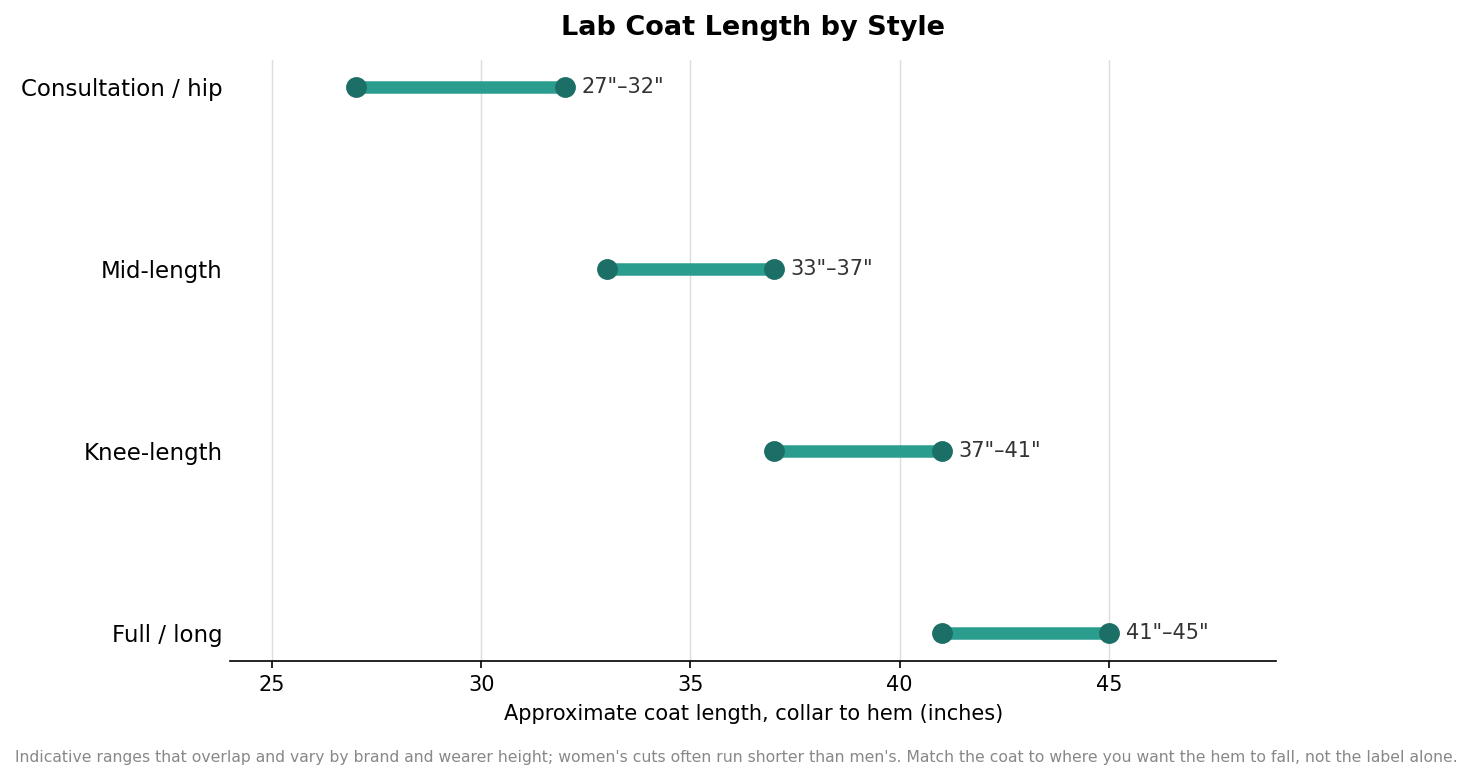
Treat those numbers as starting points that overlap in the middle. Women’s cuts frequently run a few inches shorter than men’s at the same label, and a 5-foot-2 wearer and a 6-foot-3 wearer in the same nominal length will see the hem land in very different places. The reliable approach is to decide where you want the hem to fall on a typical wearer, then match the measured length rather than trusting the style name. If you are outfitting a mixed team, ordering one length family in a full size run usually beats mixing several styles, because it keeps the look consistent and simplifies reorders.
Fabric weight sets the everyday feel
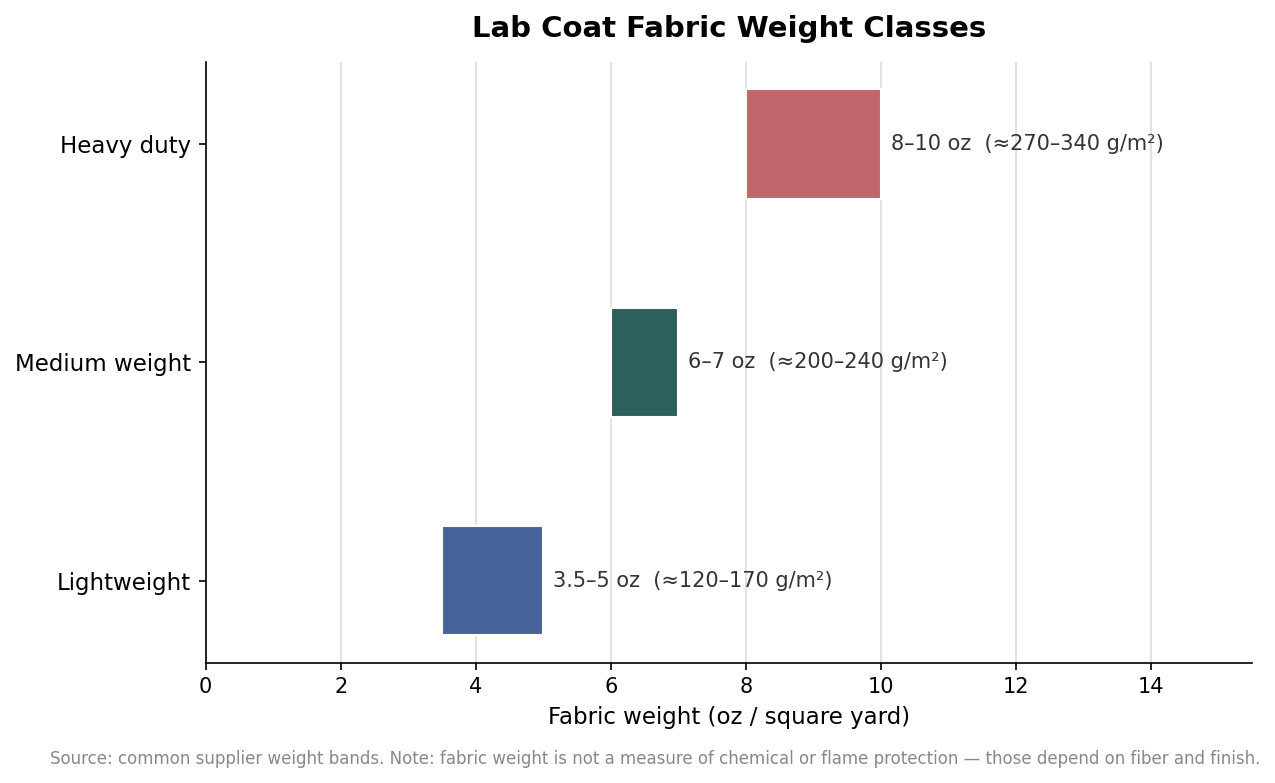
The second lever is how heavy the cloth is, measured in ounces per square yard. Lighter fabrics breathe and drape softly; heavier fabrics are more opaque, hold a crisp press, and shrug off wear and repeated laundering. Most branded lab coats today use a poly-cotton blend, commonly 65/35 or 70/30, because the polyester adds durability and wrinkle resistance while the cotton keeps some breathability. Within that family the weight range is wide, as the next chart shows.
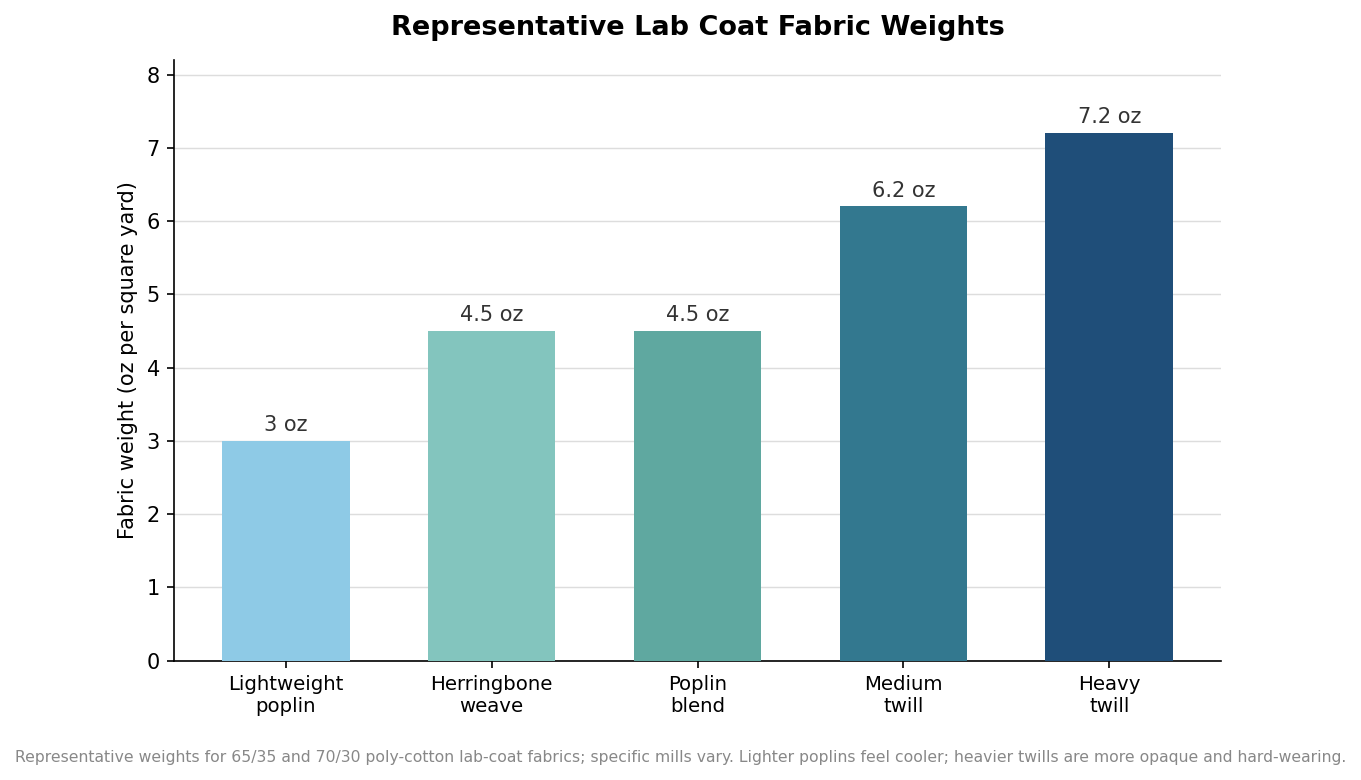
At the light end, a poplin around 3 ounces feels cool and is a genuine comfort upgrade in a warm pharmacy, a summer clinic, or anywhere air conditioning is scarce, at the cost of some opacity and body. A herringbone or lighter blend near 4.5 ounces splits the difference, staying comfortable while looking a little more substantial. The medium twill around 6.2 ounces is the workhorse most programs land on, crisp and professional without being hot. A heavy twill near 7.2 ounces is the most opaque and hard-wearing, well suited to coats that get worn hard and washed often, though it can feel warm for all-day desk-adjacent work.
Weight also interacts with how your branding looks. A heavier, denser twill gives embroidery a firmer foundation and tends to keep stitched logos looking clean over time, while very light poplins may need a backing to stop fine lettering from puckering. If crisp embroidery on the chest is central to your program, leaning toward a medium weight is a safe default.
Where protection changes the math
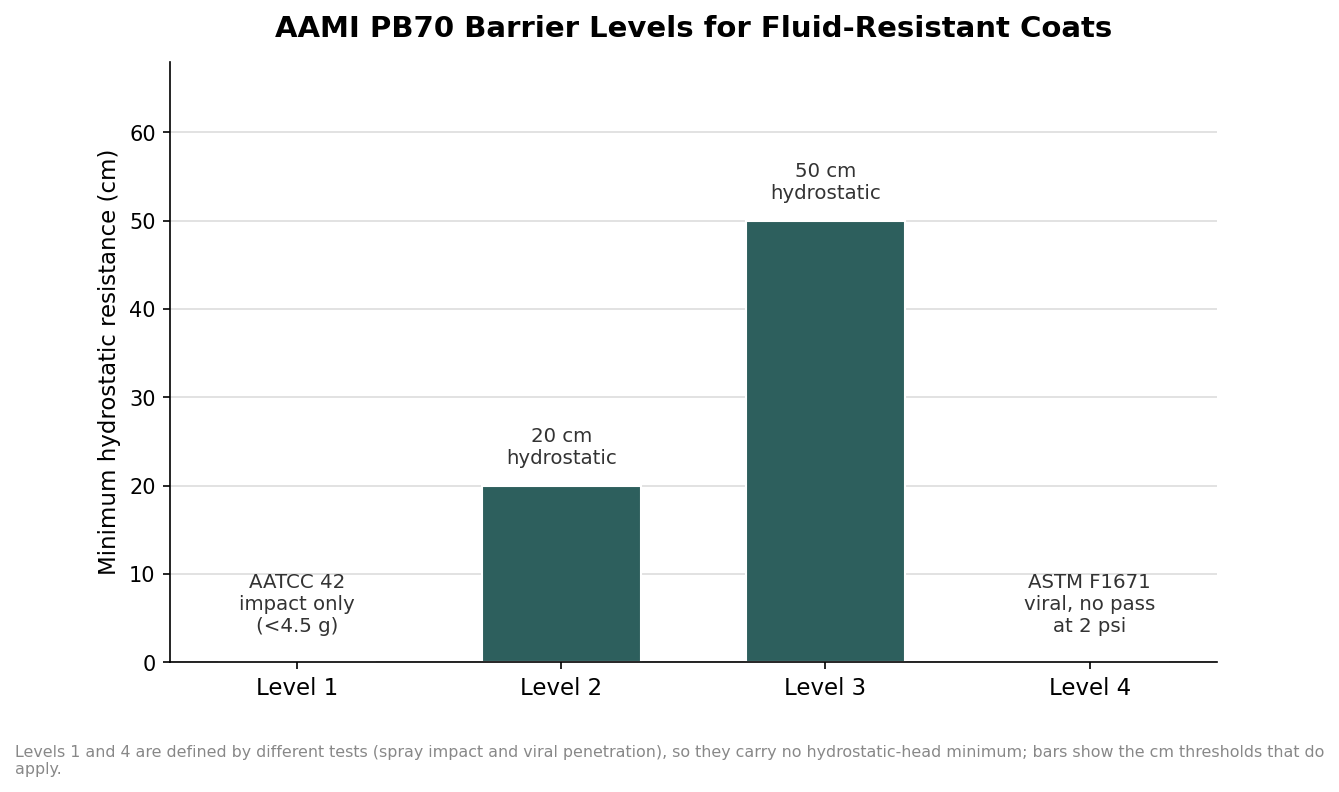
For most front-of-house medical and academic settings, length and weight are about comfort and appearance, and any professional-grade poly-cotton coat is fine. The moment real hazards enter the picture, the priorities shift. If staff handle chemicals, flammable materials, or infectious agents, the barrier and flame properties of the fabric matter more than how it drapes, and those are governed by standards rather than preference. That is a separate evaluation from the everyday comfort choices here, and it is worth reading up on barrier ratings before you commit a lab-facing team to a fabric.
In those hazard settings, coverage usually wins, which nudges you toward the longer, knee-length or full styles and often toward a snap front that can be shed quickly if something spills, along with knit cuffs that close the sleeve opening against contamination. For clean office, consult, and reception environments, comfort and a tailored look can lead, which is where the shorter lengths and lighter weights earn their place.
Putting it together for a bulk order
A practical way to specify a program is to fix three things in order: the length family that fits the role, the fabric weight that fits the environment, and only then the closures and cuffs that fit the task. A hospital ward program might settle on knee-length medium twill with a button front; a boutique dermatology office might choose hip-length herringbone for a lighter, more contemporary look; a teaching lab might specify full-length heavier twill with knit cuffs and a snap front. Each of those is a coherent set of choices rather than a single feature picked in isolation.
Because weights and lengths differ from mill to mill, request a fabric swatch and, if you can, a single sample coat in your chosen length before committing to a full run. Feeling the cloth and seeing where the hem lands on a real wearer resolves in five minutes what a spec sheet cannot, and it is far cheaper than discovering after 200 coats arrive that the fabric runs hot or the length runs long.